Personal loans can help borrowers cover planned expenses,
consolidate certain debts, or manage significant purchases.
However, before applying, it is important to understand how
personal loans work, how lenders calculate borrowing costs,
and what happens after the money reaches your account.
A personal loan generally provides a specific amount of money
that you repay over an agreed period. Many personal loans have
fixed interest rates and predictable monthly payments, although
loan features vary by lender, product, and country.
In this complete guide, LoanBari explains the personal loan
process step by step, from checking eligibility and comparing
offers to receiving funds and making your final repayment.
You will also learn how interest rates, annual percentage rates
(APR), fees, credit history, and loan terms affect the total
cost of borrowing.
Quick answer: A personal loan works by allowing
an eligible borrower to receive money from a lender and repay
the amount borrowed, plus applicable interest and fees,
according to a loan agreement. For a typical fixed-rate
installment loan, repayment happens through scheduled monthly
payments over a set term.
Educational note: This guide provides general financial
information. Loan availability, eligibility, consumer
protections, and terminology vary by location and lender.
Learn how personal loans work, including applications,
loan approval, funding, interest, and repayment.
What Is a Personal Loan?
A personal loan is a borrowing arrangement in which a lender
provides money to an individual under agreed repayment terms.
The borrower is responsible for repaying the principal,
interest, and any applicable fees.
Personal loans are commonly offered by banks, credit unions,
online lenders, and other regulated financial institutions.
The exact products and providers available depend on your
location.
Key Features of Personal Loans
- Loan principal: The original amount borrowed.
- Interest rate: The rate charged for borrowing
the money. - Loan term: The agreed repayment period.
- Monthly payment: The scheduled amount due
each month on many installment loans. - Fees: Additional charges that may apply,
such as origination or late-payment fees. - Collateral: An asset pledged to secure
a loan, when required.
For a broader overview of borrowing options, read our
complete guide to personal loans
.
How Do Personal Loans Work?
Personal loans generally follow a straightforward sequence.
A borrower requests money, the lender evaluates the
application, and an approved borrower receives an offer
describing the amount, interest rate, fees, and repayment
obligations.
If the borrower accepts the agreement and the lender
completes its requirements, the funds are disbursed.
Repayment then takes place according to the agreed schedule.
The Personal Loan Process at a Glance
- Determine how much you need to borrow.
- Review your income, debts, and credit information.
- Research lenders and available loan products.
- Check whether prequalification is available.
- Submit a complete loan application.
- Allow the lender to verify your information.
- Review the offered rate, APR, fees, and repayment terms.
- Accept the agreement if the loan is suitable.
- Receive the funds after successful processing.
- Make payments until the balance is fully repaid.
Not every lender uses exactly the same process. Some
applications require additional verification, collateral
documentation, or manual underwriting.
Personal Loan Process: Step by Step
Step 1: Decide How Much Money You Need
Begin by identifying the actual expense you want to finance.
Borrowing more than necessary can increase your total
interest costs and create a larger repayment obligation.
For example, if an essential expense costs $4,500, applying
for $8,000 without a clear reason may lead to unnecessary debt.
Consider whether savings, a payment plan, or another
financing option could cover some or all of the expense.
Step 2: Evaluate Your Financial Situation
Before applying, review your regular income, existing debts,
essential expenses, emergency savings, and credit history.
A loan payment should fit your budget without making it
difficult to afford housing, food, utilities, insurance,
and other important obligations.
Step 3: Research Potential Lenders
Different lenders may offer different rates, loan amounts,
repayment terms, fees, and eligibility requirements.
Compare reputable providers rather than assuming the first
offer will be the most affordable.
Step 4: Check Prequalification Options
Some lenders allow borrowers to check potential loan offers
before submitting a full application.
In the United States, certain prequalification processes
use a soft credit inquiry that does not affect a consumer’s
credit score. However, this is not universal, and a formal
application may involve a hard inquiry.
Always confirm the type of credit inquiry before proceeding.
Prequalification is not a guarantee of approval.
Step 5: Submit Your Application
A lender may request personal identification, employment
information, income details, existing debt information,
and banking information.
Provide accurate information and submit documents only
through verified, secure lender channels.
Step 6: Complete Verification and Underwriting
During underwriting, the lender evaluates whether the
applicant meets its lending criteria and can reasonably
manage the proposed repayment obligation.
The lender may verify income, identity, credit history,
employment, and other relevant information.
Step 7: Review the Loan Agreement
Approval alone does not mean a loan is affordable or
appropriate. Carefully review the full agreement before
accepting it.
Important details include:
- Amount borrowed and amount actually disbursed
- Interest rate and whether it is fixed or variable
- APR, where applicable
- Origination and other fees
- Monthly payment and payment due date
- Total repayment amount
- Late-payment consequences
- Early repayment conditions
- Any collateral requirements
Step 8: Receive Your Loan Funds
After the agreement is completed and any final conditions
are satisfied, the lender may transfer funds to the
borrower’s bank account or directly to another creditor.
Funding times vary. Some lenders may process eligible loans
quickly, while others require several business days or
longer.
Step 9: Begin Repayment
Once repayment begins, follow the schedule specified in
your loan agreement. Many installment loans require monthly
payments, but other arrangements exist.
Payments typically cover accrued interest and reduce
principal, although allocation rules depend on the
agreement and applicable law.
Step 10: Complete the Loan
When the outstanding principal, interest, and applicable
charges are fully paid, the loan can be closed according
to the lender’s procedures.
Retain the final payment confirmation and verify that the
account status is accurately reflected in relevant records.
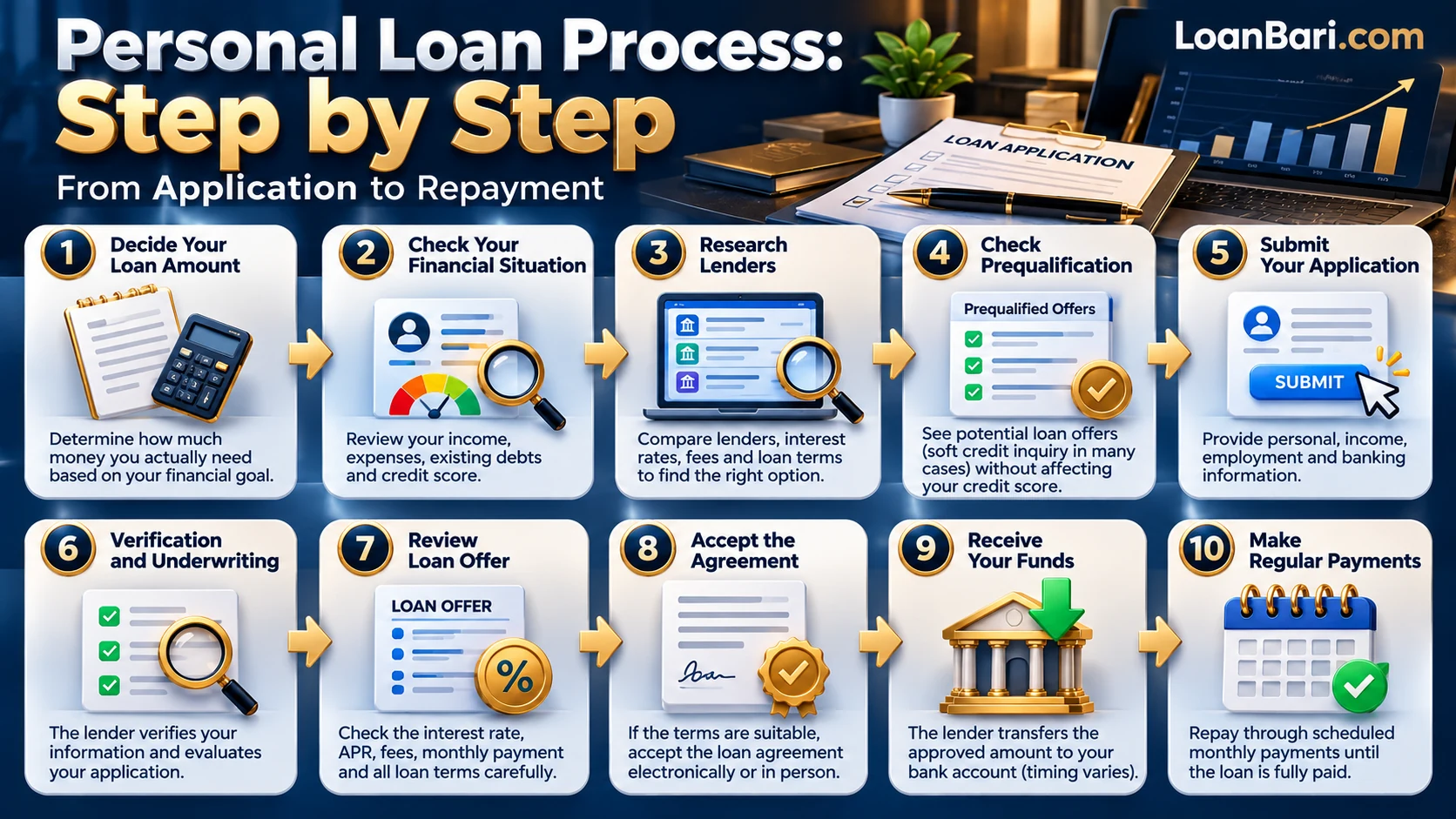
The personal loan process usually involves applying,
verification, reviewing an offer, funding, and repayment.
For a more detailed application checklist, see
how to apply for a personal loan
.
Personal Loan Example: Borrowing $10,000
A practical example makes it easier to understand how
personal loan payments work.
Suppose you borrow $10,000 through a fixed-rate,
fully amortizing installment loan with a 12% annual
interest rate and a 36-month repayment term.
| Loan Detail | Example |
|---|---|
| Loan Amount | $10,000 |
| Annual Interest Rate | 12% |
| Repayment Term | 36 Months |
| Estimated Monthly Payment | $332.14 |
| Estimated Total Repayment | Approximately $11,957.15 |
| Estimated Total Interest | Approximately $1,957.15 |
This example assumes monthly compounding, equal scheduled
payments, no additional fees, and no early or missed
payments. Actual totals can vary slightly due to rounding
and lender calculation methods.
The borrower receives $10,000 and pays approximately
$332.14 each month for 36 months. Over the repayment
period, the borrower pays approximately $1,957.15
in interest in addition to the original principal.
This example demonstrates why borrowers should compare
the total cost of a loan, not just the monthly payment.
How Personal Loan Interest Rates Work
Interest is the cost charged by a lender for providing
borrowed money. A personal loan’s interest rate affects
how much the borrower pays beyond the principal.
Rates can depend on the lender, loan type, credit profile,
income, debt obligations, loan amount, term, and market
conditions.
Fixed Interest Rates
A fixed interest rate remains unchanged throughout the
agreed fixed-rate period. On a standard fully amortizing
fixed-rate installment loan, this generally results in
predictable scheduled payments.
Variable Interest Rates
A variable interest rate can change according to the
agreement’s reference rate or adjustment mechanism.
Depending on the product, changes in the interest rate
may affect monthly payments, the repayment period,
or total interest costs.
What Determines Your Interest Rate?
- Credit history and creditworthiness
- Income and existing financial obligations
- Loan amount and repayment term
- Secured or unsecured loan structure
- Lender pricing policies
- Economic and market conditions
Learn more in our guide to
personal loan interest rates
.
Understanding APR and Personal Loan Fees
The interest rate is not always the same as the total
borrowing cost. Some personal loans also include fees
that increase the effective cost of financing.
What Is APR?
Annual percentage rate, or APR, expresses certain borrowing
costs as an annualized rate. In the United States, consumer
loan APR disclosures follow applicable rules under the
Truth in Lending Act and Regulation Z.
APR may incorporate certain finance charges in addition
to interest. The specific calculation and disclosure rules
depend on the product and jurisdiction.
When comparing similar loans, APR can provide a more
useful cost comparison than the stated interest rate alone.
However, borrowers should also examine the repayment term,
total payments, and any charges not included in APR.
Common Personal Loan Fees
| Fee | What It Means |
|---|---|
| Origination Fee | A charge associated with processing or originating a loan. |
| Late Payment Fee | A possible charge when payment is received after the permitted deadline. |
| Returned Payment Fee | A possible charge when a payment cannot be processed. |
| Prepayment Charge | A possible charge for repaying early, where permitted and specified. |
How an Origination Fee Affects Your Loan
Imagine a lender approves a $10,000 loan and deducts
a 3% origination fee from the proceeds.
- Approved loan principal: $10,000
- Origination fee: $300
- Amount received: $9,700
If the fee is withheld from the proceeds, the borrower
receives less than the face amount of the loan but may
still owe repayment based on the full $10,000 principal.
This is why it is important to check both the loan amount
and the actual funds you will receive.
Read our detailed explanation of
personal loan origination fees
.
How Monthly Personal Loan Payments Work
Many personal loans use amortization. This means the
borrower makes scheduled payments that gradually reduce
the outstanding loan balance.
With a standard fixed-rate amortizing loan, each payment
generally includes interest and principal. Early payments
often contain a larger interest portion because the
outstanding balance is higher.
As principal decreases, the interest portion usually
becomes smaller, allowing more of each scheduled payment
to reduce the remaining principal.
Monthly Payment Formula
For a standard fixed-rate, fully amortizing loan with
equal monthly payments, the payment can be estimated
using the following formula:
M = P × [r(1 + r)n] /
[(1 + r)n − 1]
Where:
- M: Monthly payment
- P: Loan principal
- r: Monthly interest rate expressed as a decimal
- n: Total number of monthly payments
For a $10,000 loan at 12% annual interest over 36 months,
the monthly rate is 0.01 and the number of payments is 36.
The estimated payment is approximately $332.14.
This formula does not automatically account for fees,
variable rates, irregular payment schedules, or other
loan-specific conditions.
How Loan Terms Affect Monthly Payments
A longer repayment term can lower the required monthly
payment, but it often increases the total interest paid
when other loan conditions remain the same.
A shorter term generally requires higher monthly payments
but can reduce the total interest expense.
Use a
personal loan calculator
to estimate payments under different borrowing scenarios.
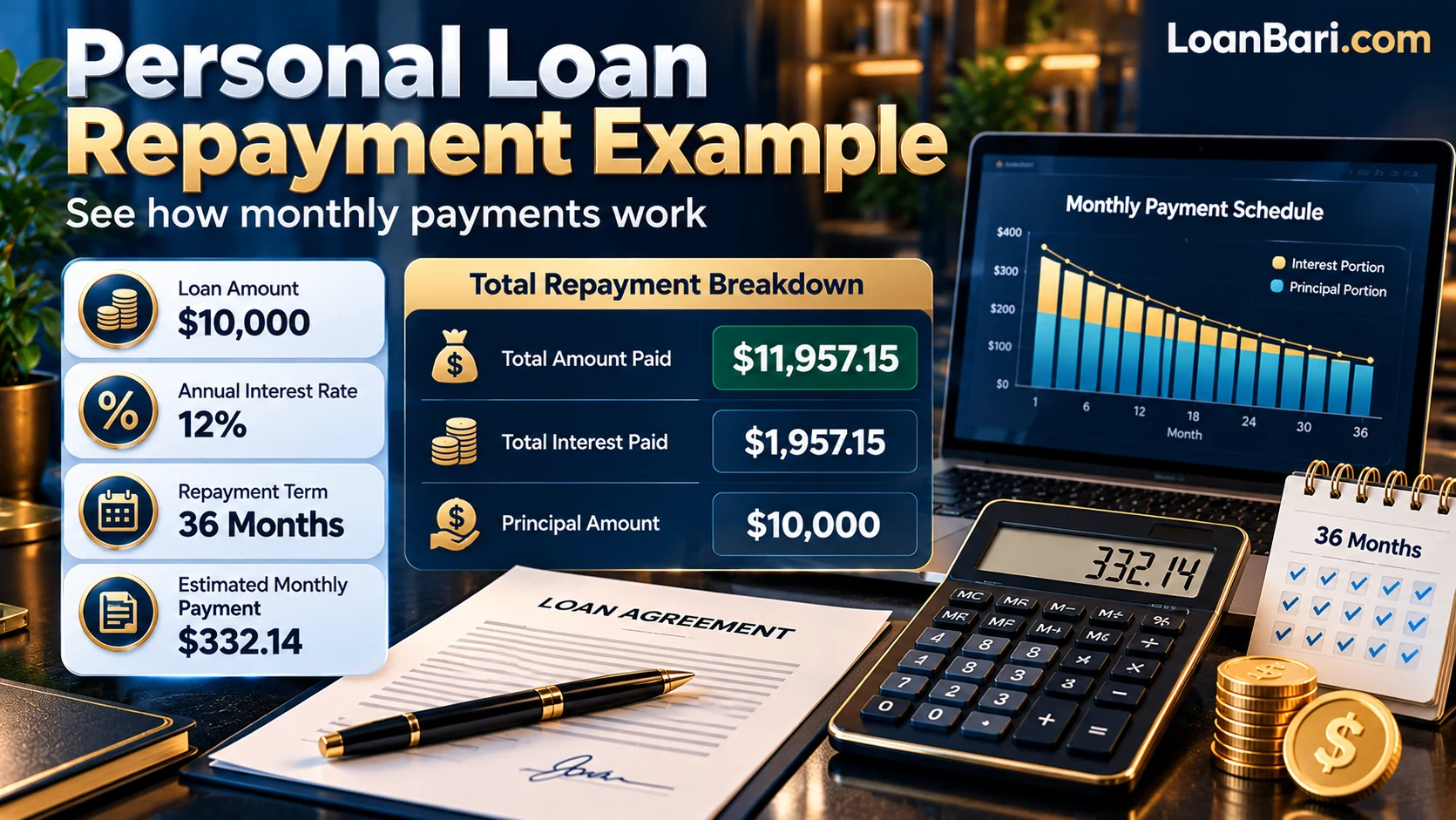
A loan calculator can help estimate monthly payments
and total interest before borrowing.
Personal Loan Eligibility Requirements
Personal loan eligibility varies by lender and loan
product. There is no single universal requirement
that guarantees approval.
Lenders may consider the following factors:
Income
Lenders often assess whether applicants have sufficient
income to support the proposed loan payments alongside
existing financial commitments.
Employment and Income Stability
Some lenders review employment history or the consistency
of income. Depending on the lender, eligible income
may come from employment, self-employment, retirement,
or other verifiable sources.
Existing Debts
Outstanding loans, credit card balances, and other
recurring obligations can affect affordability.
Credit History
Credit reports and scores may help lenders evaluate
previous repayment behavior and credit risk.
Identity and Residency Verification
Lenders generally require applicants to satisfy identity,
age, and applicable residency requirements.
Explore the full
personal loan requirements guide
for additional details.
How Credit Scores Affect Personal Loans
In markets where credit scoring is used, a credit score
may influence whether a lender approves an application
and what borrowing terms it offers.
A stronger credit profile may improve access to certain
offers, but it does not guarantee approval or a particular
interest rate.
Lenders can use different scoring models and consider
additional factors beyond a credit score.
Can You Get a Personal Loan With Bad Credit?
Some lenders consider applicants with weaker credit
histories, but the available loans may carry higher
interest rates, additional restrictions, or collateral
requirements.
Before applying, review the full repayment cost and
consider whether the loan would improve or worsen
your financial position.
Learn more about
credit scores for personal loans
.
Secured vs. Unsecured Personal Loans
Personal loans may be secured or unsecured. The main
difference is whether the borrower pledges collateral
to support the loan.
Unsecured Personal Loans
An unsecured personal loan does not require a specific
asset to be pledged as collateral. The lender generally
evaluates creditworthiness and repayment capacity.
However, unsecured does not mean risk-free. Missed
payments can result in fees, credit consequences,
collections, or legal action, depending on applicable law.
Secured Personal Loans
A secured personal loan is backed by collateral, such
as an eligible savings account or another asset accepted
by the lender.
If the borrower defaults, the lender may have rights
to the collateral according to the agreement and
applicable law.
| Feature | Secured Loan | Unsecured Loan |
|---|---|---|
| Collateral | Required | Not required |
| Approval Factors | Collateral and repayment capacity | Primarily creditworthiness and repayment capacity |
| Asset Risk | Pledged asset may be at risk | No specifically pledged asset |
| Interest Rates | May be lower in some cases | Depend on lender and borrower profile |
See our
secured vs. unsecured personal loans comparison
for a deeper explanation.
What Can Personal Loans Be Used For?
Depending on the lender’s rules, personal loans may
be used for various eligible personal expenses.
Debt Consolidation
A borrower may use a personal loan to combine several
existing debts into one repayment arrangement.
Debt consolidation can simplify payments, but it only
reduces borrowing costs if the new loan’s total cost
is favorable after accounting for fees and the term.
Home Improvements
Personal loans may help finance repairs or improvements,
especially when a borrower prefers not to use a
property-secured loan.
Medical Expenses
Some borrowers use personal loans for eligible medical
expenses. Before borrowing, compare insurance benefits,
provider payment plans, financial assistance, and
other available options.
Major Planned Purchases
Personal loans can sometimes finance necessary purchases
that would otherwise require a large upfront payment.
Emergency Expenses
A loan may be considered when urgent costs exceed
available savings, although borrowing can create
additional financial pressure.
Some lenders prohibit particular uses, such as certain
business expenses, educational costs, investments,
or other restricted activities. Always check the
agreement before applying.
Benefits of Personal Loans
Personal loans may offer advantages when their terms
match the borrower’s financial needs.
- Predictable payments: Many fixed-rate
installment loans have scheduled payments that
support budgeting. - Flexible permitted uses: Some products
allow borrowers to finance different personal expenses. - Potential debt consolidation: A suitable
loan may simplify repayment or reduce costs. - No collateral for unsecured loans:
Borrowers may qualify without pledging a specific asset. - Defined repayment period: Many installment
loans provide a scheduled end date when payments
are made as agreed.
These benefits depend on the actual loan terms and
the borrower’s circumstances.
Risks and Disadvantages of Personal Loans
Borrowing money creates a legal repayment obligation.
Personal loans can become expensive or difficult to
manage when the repayment amount exceeds a borrower’s
available budget.
Interest and Fees Increase Costs
The total repayment amount can be significantly higher
than the original loan principal.
Missed Payments Can Have Consequences
Depending on the agreement and local rules, missed
payments may result in fees, credit reporting,
collection activity, or other consequences.
Longer Terms Can Increase Total Interest
Lower monthly payments may appear attractive, but
extending the repayment period can increase the
total amount paid over time.
Secured Loans Can Put Assets at Risk
Defaulting on a secured loan may put pledged collateral
at risk.
Borrowing Can Encourage Additional Debt
Using a loan to consolidate debt without addressing
the reasons the debt accumulated may leave borrowers
with both the new loan and additional balances.
How to Compare Personal Loan Offers
Comparing loan offers is one of the most important
steps in responsible borrowing.
Look beyond promotional rates and evaluate the complete
financial obligation.
Personal Loan Comparison Checklist
- Compare APR or the relevant local cost disclosure.
- Check the stated interest rate.
- Review all origination and other fees.
- Compare monthly payments.
- Calculate total repayment costs.
- Check whether rates are fixed or variable.
- Review repayment term options.
- Confirm early repayment rules.
- Check late-payment policies.
- Verify the lender’s identity and regulatory status.
Example: Comparing Two Loan Offers
Consider two hypothetical $10,000 loans with a
36-month repayment term and no fees.
| Feature | Loan A | Loan B |
|---|---|---|
| Principal | $10,000 | $10,000 |
| Annual Interest Rate | 10% | 15% |
| Term | 36 Months | 36 Months |
| Estimated Monthly Payment | $322.67 | $346.65 |
| Estimated Total Interest | $1,616.19 | $2,479.52 |
Under these assumptions, Loan A has a lower monthly
payment and lower total interest cost.
Real offers may differ in fees, eligibility, rate
structures, and other conditions. Always compare
actual disclosures before deciding.
Read our
guide to comparing personal loans
for additional considerations.
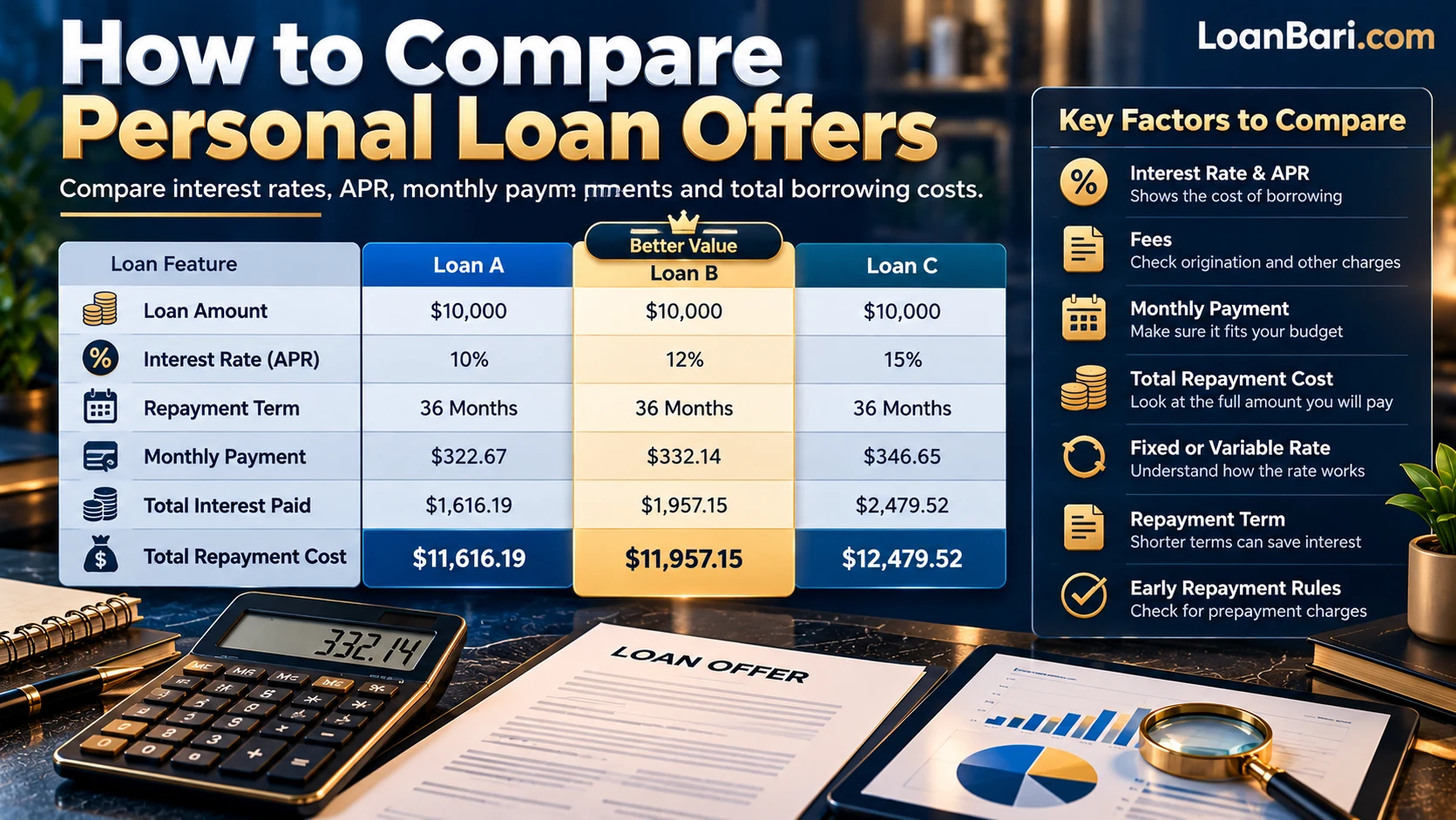
Compare interest rates, fees, monthly payments,
and total repayment costs before choosing a loan.
Tips for Managing Personal Loan Repayment
Build Payments Into Your Monthly Budget
Include the scheduled loan payment alongside essential
living expenses and other financial obligations.
Consider Payment Reminders
Calendar reminders or automatic payments may help
reduce missed due dates. Confirm sufficient funds
are available before scheduled withdrawals.
Review Your Statements
Regularly check your balance, payment history,
interest charges, and any fees.
Understand Early Repayment Rules
Paying additional principal may reduce interest
on some loans, but the savings depend on the
agreement, interest calculation method, and
any applicable prepayment charges.
Learn more about
paying off a personal loan early
.
Contact the Lender Before Missing Payments
If financial difficulties arise, contact your lender
as early as possible to ask whether assistance
or alternative repayment arrangements are available.
Any modified repayment arrangement should be
reviewed carefully and confirmed in writing.
Alternatives to Personal Loans
A personal loan is not always the most suitable
financing option. The right alternative depends
on the expense, urgency, repayment capacity,
and available financial resources.
Emergency Savings
Using available savings may avoid interest charges,
although maintaining sufficient emergency reserves
is also important.
Provider Payment Plans
Some medical providers, service companies, and
retailers offer installment arrangements.
Compare all fees and financing terms.
Credit Cards
Credit cards can provide flexible borrowing,
but carrying a balance may result in substantial
interest costs.
Secured Financing
Asset-backed financing may offer different pricing,
but it introduces collateral-related risks.
Financial Assistance Programs
Depending on the expense and location, nonprofit,
employer, community, or government assistance
programs may be available.
Compare alternatives based on the full cost,
eligibility, risks, and your ability to repay.
How to Avoid Personal Loan Scams
Fraudulent lenders and impersonators sometimes use
convincing websites, advertisements, messages,
or phone calls to target people seeking loans.
Common Warning Signs
- Promises of guaranteed approval regardless of circumstances
- Requests for unusual upfront payments to release funds
- Pressure to act immediately without reviewing terms
- Requests for passwords or verification codes
- Unverifiable company names or contact information
- Loan offers that differ from the written agreement
- Requests to pay through gift cards or cryptocurrency
Legitimate lenders may charge lawful, disclosed fees,
so the presence of a fee alone does not establish fraud.
The warning sign is an unexplained or suspicious
payment demand, particularly before any legitimate
lending process has been completed.
How to Check a Lender
Verify the lender through official registration or
regulatory resources in your jurisdiction. Read
independent information, confirm the website address,
and review all loan documents.
In the United States, consumers can use relevant
state regulatory resources and information from
agencies such as the Consumer Financial Protection
Bureau and Federal Trade Commission.
Frequently Asked Questions About How Personal Loans Work
1. How do personal loans work in simple terms?
A lender provides an approved amount of money, and
the borrower repays it with applicable interest and
fees under an agreed schedule.
2. Do personal loans have fixed monthly payments?
Many fixed-rate installment personal loans have
predictable monthly payments. Variable-rate loans
or other products may work differently.
3. How long does it take to get a personal loan?
Processing times vary by lender, applicant,
verification requirements, and banking systems.
Some applications are completed quickly, while
others take several business days or longer.
4. What happens after a personal loan is approved?
The borrower generally reviews and accepts the
loan agreement, completes any remaining requirements,
receives funds, and begins repayment according
to the agreed schedule.
5. Can I use a personal loan for anything?
Not necessarily. Many lenders permit several
personal uses but restrict certain expenses.
Check the loan agreement for permitted purposes.
6. What is the difference between interest rate and APR?
The interest rate measures the cost of borrowing
principal, while APR may include certain additional
finance charges expressed as an annualized rate,
depending on applicable rules.
7. Can I repay a personal loan early?
Many personal loans allow early repayment, but
the conditions and potential charges vary.
Review your agreement before making extra payments.
8. Does applying for a personal loan affect credit?
In the United States, a formal application may
result in a hard credit inquiry that can affect
a credit score. Some prequalification checks
use soft inquiries instead.
9. Can a personal loan improve my credit score?
Repayment behavior may affect credit history
where the lender reports to credit bureaus.
On-time payments may be beneficial, while missed
payments can be harmful. A score improvement
is not guaranteed.
10. What happens if I miss a payment?
Depending on the agreement and local law, missed
payments may result in fees, additional interest,
credit reporting consequences, or collection activity.
11. Are personal loans secured or unsecured?
Both types exist. Unsecured loans do not require
specifically pledged collateral, while secured
loans are backed by eligible assets.
12. Is a longer loan term better?
A longer term may reduce the monthly payment,
but it can increase total interest costs.
The appropriate term depends on affordability
and the total borrowing expense.
13. How much can I borrow with a personal loan?
Available loan amounts depend on the lender,
loan product, creditworthiness, income, and
other eligibility factors.
14. What documents are required for a personal loan?
Common requirements may include identification,
proof of income, employment information,
banking details, and other verification documents.
15. Is personal loan interest tax-deductible?
Tax treatment depends on local law and how loan
proceeds are used. In the United States, interest
on a personal loan used for ordinary personal
expenses is generally not deductible, although
specific exceptions may apply. Consult a
qualified tax professional for your circumstances.
16. Can I get a personal loan without a credit history?
Some lenders may consider applicants with limited
credit history using other financial information.
Approval and available terms depend on lender
policies and applicable regulations.
17. What is the most important thing to check before accepting a loan?
Confirm that you can afford the scheduled payments
and understand the APR or equivalent cost measure,
total repayment amount, fees, and consequences
of missing payments.
Final Thoughts: Understanding How Personal Loans Work
Understanding how personal loans work can help
borrowers make better-informed decisions and
avoid unnecessary borrowing costs.
The process typically begins with determining
a borrowing need, comparing lenders, submitting
an application, reviewing the loan agreement,
receiving funds, and making scheduled repayments.
Before accepting any personal loan, focus on
affordability, interest rates, APR, fees,
repayment terms, and the total amount you
will repay.
A personal loan can be useful in the right
circumstances, but it is not free money
and should not replace a realistic financial plan.
Continue learning with LoanBari’s
Personal Loans: Rates, Requirements & Complete Guide
.
Sources and Further Reading
The following official resources provide additional
consumer information about borrowing, loan costs,
credit reports, and financial scams. Some resources
describe United States laws and practices specifically.
Financial Disclaimer
Disclaimer: LoanBari.com provides
general educational information about loans,
insurance, and personal finance. Content on
this website is not personalized financial,
legal, tax, or lending advice.
LoanBari does not guarantee loan approval,
specific interest rates, funding times,
or financial outcomes. Loan offers and
consumer protections vary by lender,
product, and jurisdiction.
All numerical examples in this article are
hypothetical and provided for educational
purposes only. Actual loan payments and
borrowing costs may differ.
Review official loan disclosures and consider
consulting a qualified professional before
making significant financial decisions.