Secured vs Unsecured Personal Loans: Key Differences Explained
When you need to borrow money, one of the most important decisions
is choosing between secured and unsecured personal loans. Although
both types of loans can provide funds for eligible expenses, they
differ in collateral requirements, lender risk, interest rates,
approval criteria, and the consequences of missed payments.
Understanding secured vs unsecured personal loans
can help you compare offers more confidently and avoid borrowing
terms that may place unnecessary pressure on your finances.
A secured personal loan requires an eligible asset or account as
collateral. An unsecured personal loan generally does not require
you to pledge a specific asset. However, both loans create a legal
repayment obligation, and neither guarantees approval or
favorable borrowing terms.
In this complete guide, we explain how secured and unsecured
personal loans work, compare their costs and risks, discuss
eligibility requirements, and provide practical examples to
help you evaluate your options.
Quick Answer: Secured personal loans are backed
by collateral that the lender may claim after default. Unsecured
personal loans generally rely on the borrower’s creditworthiness,
income, debts, and ability to repay rather than pledged assets.
Secured borrowing may offer favorable terms in some situations,
but it introduces collateral risk. Unsecured borrowing avoids
pledging specific collateral but can still result in collection
activity and credit damage if payments are missed.
Important: This guide is for educational purposes. Loan terms,
credit reporting practices, collateral enforcement rules, and
consumer protections vary by lender and jurisdiction.
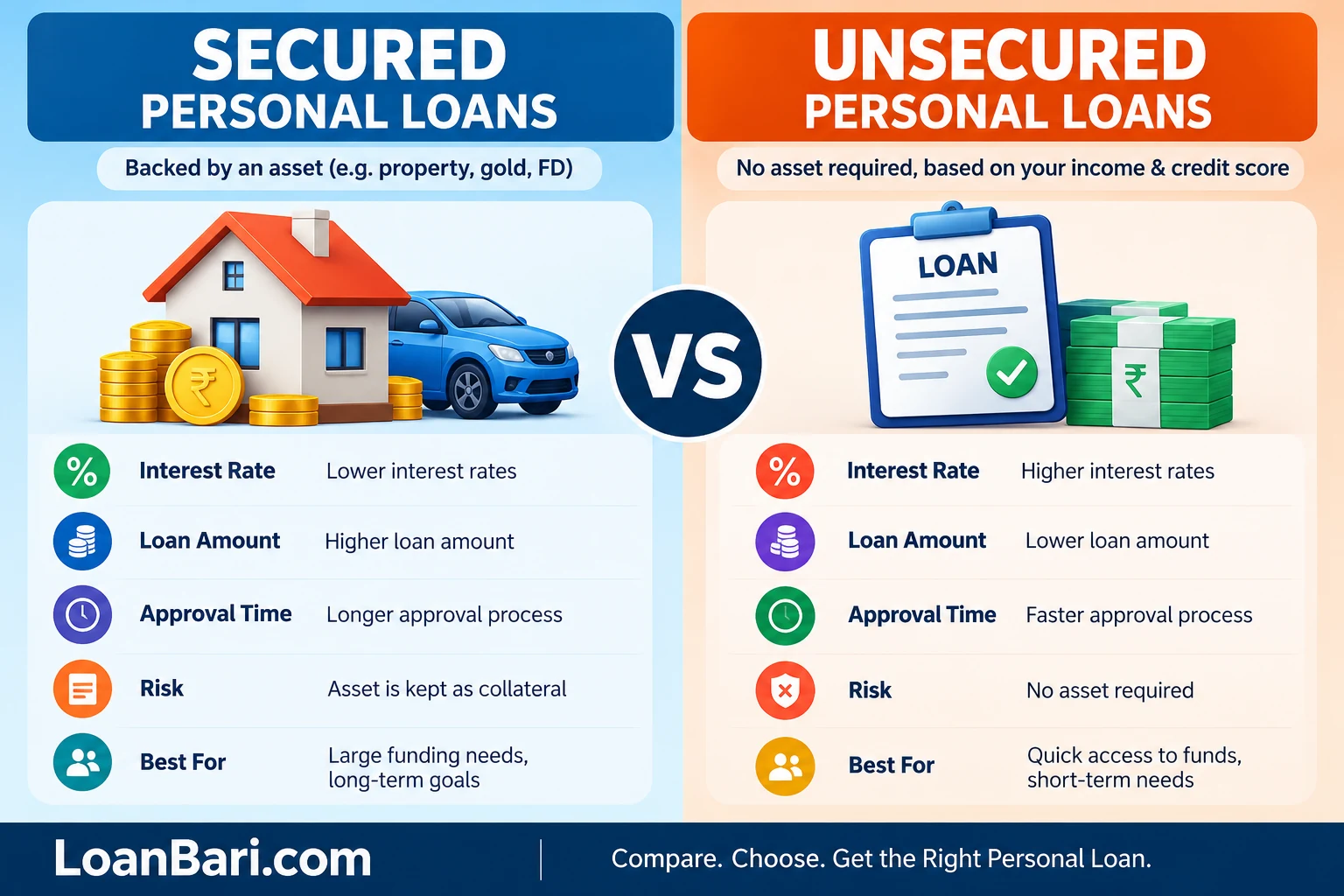
borrowing costs, eligibility, and financial risks.
What Are Secured Personal Loans?
A secured personal loan is a loan supported by
collateral. Collateral is an asset or financial account that
provides additional protection to the lender if the borrower
fails to repay the debt according to the loan agreement.
Depending on the lender and loan product, acceptable collateral
may include a savings account, certificate of deposit, vehicle,
or another eligible asset.
For example, some financial institutions offer savings-secured
loans in which funds held in an eligible deposit account serve
as security. The borrower may be unable to access the pledged
balance until the loan obligations are satisfied.
Key Features of Secured Personal Loans
- Require an eligible asset or financial account as collateral.
- May offer lower interest rates than comparable unsecured products.
- May provide additional borrowing options for some applicants.
- Can require collateral ownership and valuation documentation.
- May restrict access to pledged assets during repayment.
- Can result in loss of collateral after default.
Collateral does not guarantee approval. Lenders may still
evaluate income, credit history, existing debt, and overall
repayment capacity.
Common Examples of Secured Personal Loans
- Savings-secured personal loans.
- Certificate-of-deposit-secured loans.
- Some vehicle-secured installment loans.
- Other asset-backed personal loan products offered by eligible lenders.
Not every lender offers these products, and not every asset
qualifies as collateral.
What Are Unsecured Personal Loans?
An unsecured personal loan generally does not
require a borrower to pledge a specific asset as collateral.
Instead, the lender evaluates the applicant’s financial profile
and ability to repay.
Lenders commonly consider credit history, income, outstanding
debts, employment information, and other underwriting factors.
Unsecured personal loans are available from various banks,
credit unions, and online lenders, depending on the market
and jurisdiction.
Key Features of Unsecured Personal Loans
- No specific collateral is generally required.
- Approval often depends heavily on credit and affordability.
- Rates vary based on borrower and lender characteristics.
- Many loans provide fixed monthly installment payments.
- Some lenders offer online applications and preliminary estimates.
- Late payments can result in fees, credit damage, and collections.
What Can Unsecured Personal Loans Be Used For?
Depending on lender restrictions, common uses may include:
- Debt consolidation.
- Home repairs or improvements.
- Eligible medical or emergency expenses.
- Major planned purchases.
- Moving expenses.
- Other permitted personal expenses.
Some lenders restrict business expenses, education-related
expenses, investments, or other uses. Always check the
loan agreement.
For a broader explanation of the borrowing process, read
How Do Personal Loans Work?
Secured vs Unsecured Personal Loans: Key Differences
The most important distinction is collateral. However,
the presence or absence of collateral can also affect
loan pricing, documentation, approval requirements,
and default consequences.
| Feature | Secured Personal Loans | Unsecured Personal Loans |
|---|---|---|
| Collateral | Required | Generally not required |
| Approval Factors | Collateral, credit, income, affordability | Credit, income, affordability |
| Interest Rates | May be lower in comparable circumstances | May be higher depending on borrower risk |
| Asset Risk | Pledged collateral may be lost after default | No specific asset pledged at origination |
| Credit Requirements | Vary by lender and collateral type | Vary by lender and applicant profile |
| Application | May require collateral documentation | May involve fewer asset-related checks |
| Loan Amount | May depend partly on collateral value | May depend on income, credit, and affordability |
| Default | Collections and potential collateral enforcement | Collections and potential legal action |
| Repayment Terms | Depend on lender and product | Depend on lender and product |
| Best Fit | Borrowers comfortable with collateral risk | Borrowers seeking to avoid pledging assets |
Neither loan type is automatically cheaper, easier,
or safer for every borrower. The actual offer matters
more than the label.
How Do Secured Personal Loans Work?
Secured borrowing involves the normal loan application
process plus an assessment of the proposed collateral.
Step 1: Determine Your Loan Amount
Start by identifying the expense and the amount you
actually need. Borrowing more than necessary increases
your repayment obligation.
Step 2: Identify Acceptable Collateral
Ask the lender which assets qualify. The lender may
consider ownership, current value, existing liens,
and other restrictions.
Step 3: Review Your Financial Situation
Calculate your regular income, monthly expenses,
existing debt payments, and available emergency savings.
Step 4: Compare Secured Loan Offers
Review APR, fees, repayment terms, collateral rules,
and potential consequences of default.
Step 5: Submit Your Application
Provide the requested identification, financial
information, and collateral documentation.
Step 6: Complete Verification and Underwriting
The lender may verify your ability to repay and
assess the collateral.
Step 7: Review the Loan Agreement
Pay particular attention to the security agreement,
payment schedule, default provisions, and conditions
for releasing the collateral.
Step 8: Receive the Loan Funds
If approved and accepted, funds are disbursed
according to the lender’s procedures.
Step 9: Make Regular Payments
Pay the required amount on time and monitor your
remaining balance.
Step 10: Confirm Collateral Release
After satisfying the loan, obtain confirmation
that the lender’s security interest or account
restriction has been released as required.
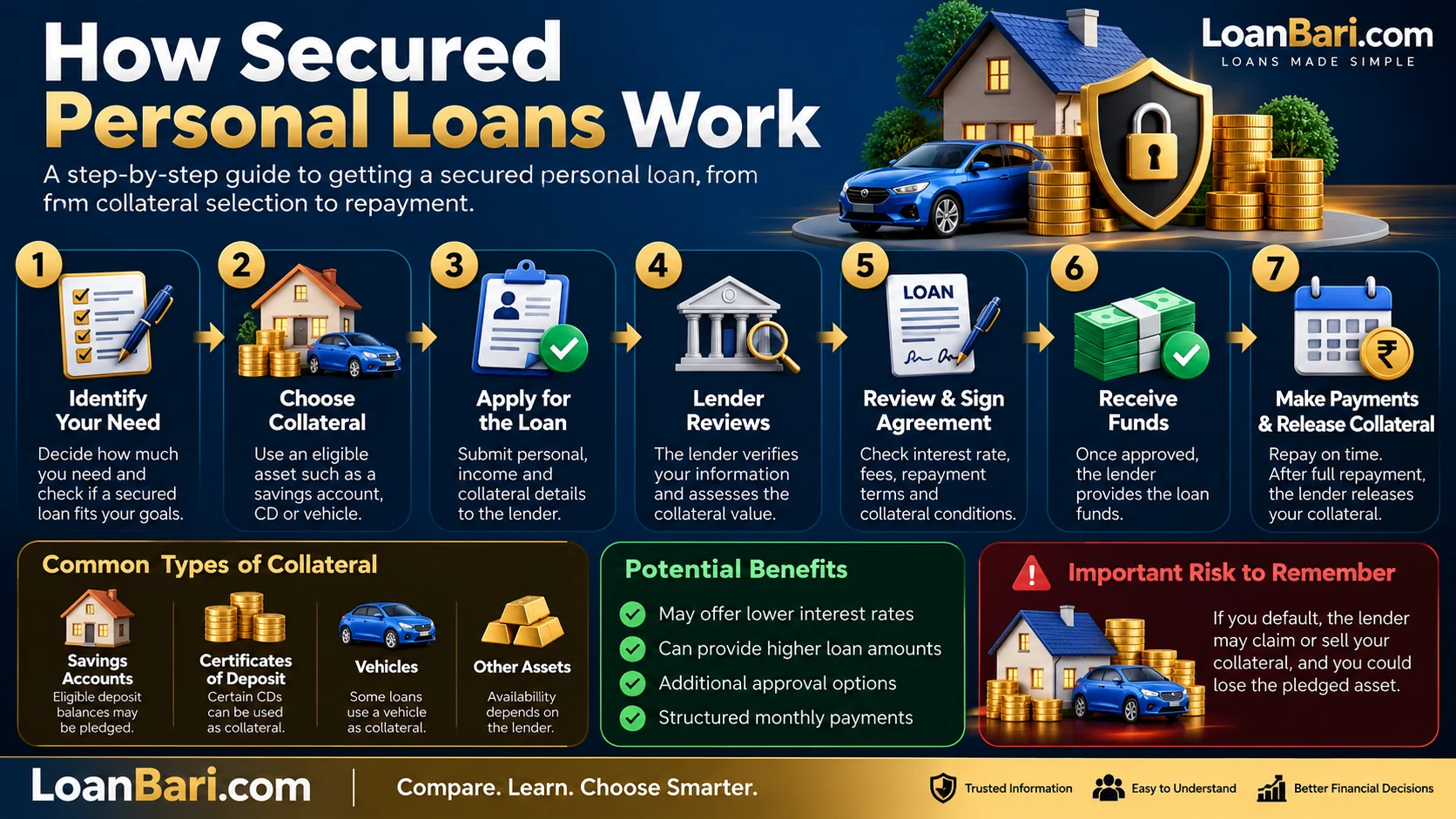
The secured personal loan process includes collateral
verification, lender approval, funding, and repayment.
How Do Unsecured Personal Loans Work?
Unsecured personal loans typically involve evaluating
the borrower’s financial information without requiring
a specific pledged asset.
Step 1: Estimate an Affordable Payment
Decide how much you need and calculate a payment
that fits your monthly budget.
Step 2: Research Lenders
Compare eligibility requirements, interest rates,
APR, fees, and repayment terms.
Step 3: Check Prequalification Options
Some lenders provide preliminary loan estimates,
sometimes using a soft credit inquiry.
Prequalification is not guaranteed approval.
Step 4: Submit a Formal Application
Provide personal identification, income information,
employment details, and other required documents.
Step 5: Complete the Credit Review
The lender evaluates creditworthiness, existing
obligations, and repayment capacity.
Step 6: Review Your Offer
Check the disclosed APR, total borrowing cost,
monthly payment, fees, and repayment schedule.
Step 7: Accept the Agreement
If the terms are suitable, complete the required
acceptance process.
Step 8: Receive and Repay the Funds
After disbursement, make scheduled payments
until the balance is paid in full.
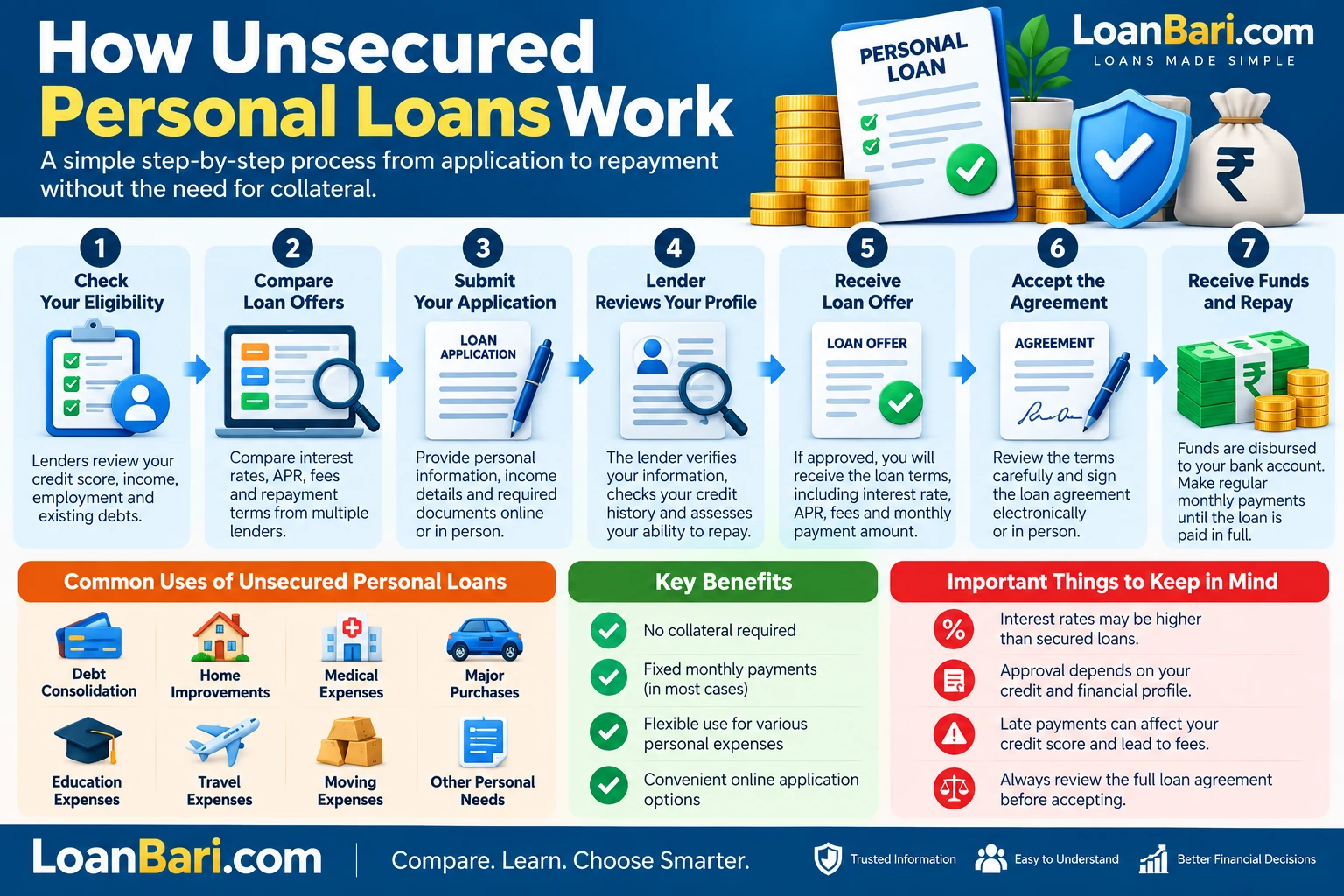
Unsecured personal loans generally rely on
creditworthiness and repayment capacity rather
than pledged collateral.
Collateral Requirements for Secured Personal Loans
Collateral provides a lender with a potential source
of recovery if the borrower defaults. The rights
and obligations associated with collateral are
defined by the agreement and applicable law.
Savings Accounts
Some lenders accept eligible savings balances
as collateral. Access to pledged funds may be
restricted during the loan term.
Certificates of Deposit
Certain deposit-secured loans use eligible
certificates of deposit. The lender may impose
restrictions on withdrawing or closing the account.
Vehicles
Some installment loan products are secured by
vehicles. The lender may have rights to repossess
the vehicle after default, subject to legal rules.
Other Eligible Assets
Some lenders consider other forms of collateral,
but acceptable assets vary considerably.
Can You Continue Using Your Collateral?
That depends on the asset and agreement.
A borrower may continue using a vehicle while
making payments, whereas pledged deposits may
remain restricted.
What Happens When the Loan Is Fully Repaid?
The lender should release its security interest
or restriction in accordance with the contract
and applicable law. Borrowers should retain
documentation confirming the release.
Secured vs Unsecured Personal Loan Interest Rates, APR, and Fees
Interest rates are an important factor when
comparing secured and unsecured personal loans,
but they do not tell the entire story.
Why Secured Loans May Have Lower Rates
Collateral can reduce certain losses a lender
might experience after default. As a result,
some secured products offer lower rates than
comparable unsecured products.
However, lower rates are not guaranteed.
Credit history, income, loan amount, term,
fees, and lender pricing also matter.
Why Unsecured Loan Rates Vary
Because an unsecured lender does not have
specific pledged collateral, creditworthiness
and affordability may play a larger role
in loan pricing.
Interest Rate vs APR
The interest rate describes the rate charged
on the loan principal.
APR is a broader annualized measure of
borrowing cost that incorporates interest
and certain finance charges under applicable
disclosure rules.
APR requirements differ by jurisdiction.
When comparing offers, review the lender’s
actual disclosures.
Common Fees to Review
- Origination or processing fees.
- Late payment fees.
- Returned payment charges.
- Collateral administration or valuation fees.
- Early repayment charges, where applicable.
- Other contractually disclosed costs.
Fixed vs Variable Interest Rates
A fixed-rate loan generally maintains the
same contractual interest rate throughout
the agreed period.
A variable-rate loan may change according
to its contract terms, potentially affecting
payments or total borrowing costs.
Always confirm the rate type before borrowing.
Secured vs Unsecured Personal Loans: Payment Example
Consider two hypothetical loans with identical
principal amounts and repayment terms but
different fixed annual interest rates.
| Feature | Loan A | Loan B |
|---|---|---|
| Loan Amount | $10,000 | $10,000 |
| Annual Interest Rate | 10% fixed | 15% fixed |
| Term | 36 months | 36 months |
| Estimated Monthly Payment | $322.67 | $346.65 |
| Estimated Total Interest | $1,616 | $2,479 |
| Estimated Total Repayment | $11,616 | $12,479 |
These figures are approximate and assume
fully amortizing loans, monthly payments,
and no additional fees.
The example demonstrates that borrowing
costs can differ substantially even when
the principal and repayment term are the same.
It does not mean Loan A is necessarily
secured or Loan B is necessarily unsecured.
Either loan type may have different rates
depending on the actual lender and borrower.
Monthly Payment Formula
For a standard fixed-rate amortizing loan,
the estimated monthly payment can be calculated as:
M = P × [r(1 + r)^n] / [(1 + r)^n − 1]
Where:
- M = monthly payment.
- P = original loan principal.
- r = monthly interest rate.
- n = total number of monthly payments.
Actual repayment schedules may vary due to
fees, interest calculation methods, payment
dates, and contract terms.
Eligibility Requirements for Secured and Unsecured Personal Loans
Lenders use different eligibility standards.
However, several common factors may influence
approval for both loan types.
1. Credit History and Credit Score
Lenders may evaluate payment history,
outstanding balances, credit inquiries,
and other credit information.
There is no universal minimum credit score
for all personal loans.
2. Income Requirements
Lenders may request evidence of sufficient
income to support regular repayments.
Accepted income sources vary.
3. Employment and Income Stability
Employment records or consistent income
may help demonstrate repayment capacity.
Self-employed borrowers may need
additional documentation.
4. Debt-to-Income Ratio
Debt-to-income ratio compares monthly
debt obligations with gross monthly income.
DTI = Monthly Debt Payments ÷ Gross Monthly Income × 100
For example, $1,200 in monthly debt
payments divided by $4,000 in gross
monthly income produces a 30% DTI.
Different lenders apply different
affordability standards.
5. Collateral Value and Eligibility
Secured loans may also require verification
of asset ownership, acceptable value,
and existing claims against the collateral.
6. Identification and Verification
Lenders may request identification,
address information, income documents,
and other records required by law.
Documents You May Need
- Government-issued identification.
- Recent income statements or payslips.
- Bank statements.
- Employment or business income records.
- Address verification.
- Existing debt information.
- Collateral documents for secured products.
The exact documents depend on the lender
and jurisdiction.
Advantages and Disadvantages of Secured Personal Loans
Advantages of Secured Personal Loans
- Potentially competitive rates:
Some secured products offer favorable pricing. - Additional qualification options:
Collateral may help certain borrowers access
loan products. - Potentially higher limits:
Some lenders consider collateral value
when setting borrowing limits. - Structured repayment:
Installment schedules can support budgeting.
Disadvantages of Secured Personal Loans
- Risk of losing pledged collateral after default.
- Possible restrictions on savings or other assets.
- Additional documentation or valuation requirements.
- Potential collateral-related fees.
- Possible complications when selling or transferring pledged assets.
The potential benefit of lower borrowing
costs must be weighed against the risk
of losing valuable property.
Advantages and Disadvantages of Unsecured Personal Loans
Advantages of Unsecured Personal Loans
- No specific asset generally needs to be pledged.
- Applications may involve fewer collateral-related steps.
- Many products provide fixed monthly payments.
- Some lenders offer convenient online applications.
- Funds may be used for various permitted expenses.
Disadvantages of Unsecured Personal Loans
- Potentially higher interest rates for some borrowers.
- Competitive offers may require strong creditworthiness.
- Origination and other fees may apply.
- Borrowing limits may be restricted.
- Missed payments can damage credit and lead to collections.
Unsecured borrowing avoids direct collateral
risk, but it still requires responsible
repayment planning.
What Happens If You Cannot Repay a Personal Loan?
Both secured and unsecured loans can
create serious consequences when payments
are missed or the borrower defaults.
Default on a Secured Personal Loan
The lender may enforce its rights
against pledged collateral, subject
to the contract and applicable law.
Depending on the asset and jurisdiction,
this may include repossession, application
of pledged funds, or other lawful remedies.
Losing collateral may not always eliminate
any remaining balance owed.
Default on an Unsecured Personal Loan
An unsecured lender does not automatically
have a right to seize a specific asset
merely because a payment is missed.
However, the lender may pursue lawful
collections or court remedies. Depending
on local law, a judgment may permit
additional enforcement measures.
Possible Consequences for Both Loan Types
- Late payment charges.
- Negative credit reporting, where applicable.
- Collection communications.
- Additional contractual charges where lawful.
- Legal proceedings.
- Financial stress and reduced future borrowing options.
What Should You Do If Repayment Becomes Difficult?
- Contact the lender as early as possible.
- Ask about hardship programs or repayment modifications.
- Review essential expenses and available income.
- Keep records of lender communications.
- Consider reputable nonprofit credit counseling where available.
Do not assume that ignoring missed payments
will make the debt disappear.
Secured vs Unsecured Personal Loans: Which Is Better?
The better loan depends on your financial
needs, credit profile, available collateral,
budget, and tolerance for risk.
When a Secured Personal Loan May Be Suitable
A secured loan may be worth considering
when you have eligible collateral,
receive meaningfully better terms,
and can afford repayments without
putting an essential asset at
unacceptable risk.
When an Unsecured Personal Loan May Be Suitable
An unsecured loan may be preferable
when you qualify for affordable terms
and want to avoid pledging a vehicle,
savings account, or other asset.
Questions to Ask Before Choosing
- What is the total borrowing cost?
- Can I comfortably afford every payment?
- Would default put an essential asset at risk?
- What fees and penalties apply?
- Is the interest rate fixed or variable?
- How long will repayment take?
- Are there safer or less expensive alternatives?

eligibility, and repayment affordability
before choosing a personal loan.
How to Compare Secured and Unsecured Personal Loan Offers
Compare APR
Review the disclosed annual percentage rate
and understand which finance charges it includes.
Compare Total Repayment
A lower monthly payment may result from
a longer term and may not mean a lower
overall borrowing cost.
Compare Fees
Check origination, late payment, collateral,
and early repayment charges.
Check the Repayment Schedule
Confirm payment frequency, due dates,
loan term, and whether the payment
amount can change.
Review Collateral Terms
For secured loans, identify the exact
asset pledged and the lender’s rights
after default.
Check Lender Legitimacy
Verify the lender’s identity and
appropriate authorization or licensing
where required.
Read the Agreement Carefully
Do not rely only on marketing claims.
The written agreement and applicable
disclosures determine your obligations.
Practical Examples of Secured and Unsecured Borrowing
Example 1: Savings-Secured Borrowing
A borrower has eligible savings and
is offered a loan secured by part
of the account balance.
The borrower should compare the
interest savings with the disadvantage
of temporarily restricting access
to emergency funds.
Example 2: Unsecured Debt Consolidation
A borrower with several existing
debts considers an unsecured loan
to combine payments.
The new loan may simplify repayment,
but it only saves money if the overall
cost is favorable after accounting
for rates, fees, and loan duration.
Example 3: Vehicle-Secured Borrowing
A borrower considers using a vehicle
as collateral. Even if the rate is
lower, default could threaten access
to transportation.
If the vehicle is essential for work
or family responsibilities, that
risk deserves serious consideration.
Example 4: Borrower With Strong Credit
A borrower with strong credit and
stable income receives a competitive
unsecured loan offer.
If the total cost is similar to a
secured alternative, avoiding
collateral risk may be valuable.
These examples are hypothetical and
do not represent actual offers.
Alternatives to Secured and Unsecured Personal Loans
Borrowing is not always the most
appropriate solution. Consider
other options before accepting
a new debt obligation.
Use Available Savings
Savings may help avoid interest
charges, provided you retain
enough money for emergencies.
Delay Nonessential Purchases
Saving for a planned expense
may be less costly than borrowing.
Ask About Payment Arrangements
Some service providers offer
payment plans. Compare any
associated fees and conditions.
Explore Credit Union Products
Depending on your eligibility
and location, credit unions
may offer suitable alternatives.
Seek Assistance for Essential Expenses
Community programs, employer
benefits, or hardship assistance
may help with certain expenses.
Review Existing Debt Options
If you are already struggling
with debt, consider discussing
available hardship options
with your current creditors.
Important Personal Loan Safety Tips
Whether you choose secured or
unsecured borrowing, protect
your financial information
and verify the lender.
- Research the lender before submitting sensitive information.
- Check applicable licensing or registration requirements.
- Read all fees and repayment terms before signing.
- Be cautious of guaranteed approval claims.
- Avoid sending money through unusual or untraceable payment methods.
- Do not share passwords or one-time security codes.
- Keep copies of loan disclosures and agreements.
- Confirm how to contact the lender for repayment assistance.
Be particularly cautious if a
company pressures you to act
immediately or refuses to provide
clear written loan terms.
Frequently Asked Questions About Secured vs Unsecured Personal Loans
1. What is the main difference between secured and unsecured personal loans?
Secured loans require collateral.
Unsecured loans generally do not
require a specific pledged asset.
Both must be repaid according
to the loan agreement.
2. Are secured personal loans easier to get?
They may offer additional
qualification options for some
borrowers, but approval depends
on lender requirements and
repayment capacity.
3. Do secured personal loans have lower interest rates?
Sometimes. Collateral can reduce
certain lender risks, but rates
also depend on credit, income,
loan terms, and lender pricing.
4. Can I get an unsecured personal loan with bad credit?
Some lenders consider applicants
with imperfect credit, although
rates may be higher and approval
is not guaranteed.
5. What assets can secure a personal loan?
Depending on the lender, eligible
assets may include certain savings
accounts, certificates of deposit,
vehicles, or other approved collateral.
6. Can I lose my car if I default on a secured loan?
If the vehicle is pledged as
collateral, repossession may
be possible under the agreement
and applicable law.
7. Can an unsecured lender take my property?
An unsecured lender does not
begin with a security interest
in a specific pledged asset.
However, lawful court and
collection remedies may become
available after default.
8. Does collateral guarantee loan approval?
No. Lenders may still review
income, credit history, debts,
and ability to repay.
9. Do secured and unsecured loans affect credit scores?
They can, depending on credit
reporting practices. Payment
history, inquiries, and defaults
may influence credit scores.
10. Can I repay a secured loan early?
Many loans permit early
repayment, but borrowers
should review any applicable
fees and collateral-release
requirements.
11. Are unsecured loans safer?
They avoid pledging specific
collateral but still involve
financial obligations and
potential consequences
after default.
12. Which type is better for debt consolidation?
Compare the total borrowing
cost, affordability, fees,
and collateral risk.
Neither type is automatically
better for every borrower.
13. Can a secured personal loan help build credit?
It may help establish positive
payment history if the lender
reports payments to relevant
credit reporting agencies.
14. Is a secured personal loan the same as a mortgage?
No. Mortgages are specialized
real-estate-secured loans with
distinct legal and contractual
requirements.
15. What credit score is needed for an unsecured personal loan?
There is no universal minimum
score. Requirements differ
between lenders and products.
16. Can a secured personal loan have fees?
Yes. Depending on the product,
fees may include origination,
administration, late payment,
or collateral-related charges.
17. Can an unsecured personal loan have a fixed interest rate?
Yes. Many unsecured installment
loans have fixed rates, although
other rate structures may exist.
18. Does a lower monthly payment mean a cheaper loan?
Not necessarily. A longer
repayment period can reduce
monthly payments while
increasing total interest.
19. Can I use a personal loan for home improvements?
Some lenders permit this use.
Always check product restrictions
and compare costs with
other financing options.
20. How should I choose between secured and unsecured loans?
Compare APR, total repayment
cost, fees, eligibility,
collateral risk, and monthly
affordability before deciding.
Final Thoughts: Secured vs Unsecured Personal Loans
Understanding secured vs unsecured personal loans
is essential when comparing borrowing options.
Secured personal loans involve collateral
and may provide favorable terms in certain
situations, but default can put the
pledged asset at risk.
Unsecured personal loans generally do
not require collateral, although they
may involve higher borrowing costs
for some applicants.
The best decision depends on your
financial circumstances, available
loan offers, repayment capacity,
and comfort with risk.
Before accepting any loan, review
the full agreement, compare the
total cost, and make sure the
repayment schedule fits your budget.