How to Apply for a Personal Loan: Step-by-Step Guide
Applying for a personal loan can be easier when you understand the process before submitting an application. Whether you want to consolidate debt, cover an unexpected expense, pay for a major purchase, or finance a home improvement project, taking time to compare lenders and review the terms can help you make a more informed borrowing decision.
The personal loan application process generally involves reviewing your financial situation, checking potential loan options, comparing interest rates and fees, completing an application, and reviewing the lender’s decision. The exact process varies by lender, loan amount, and applicant circumstances.
Quick Answer: How Do You Apply for a Personal Loan?
To apply for a personal loan, follow these general steps:

- Decide how much money you need and what you will use it for.
- Review your credit, income, and existing debt.
- Check whether lenders offer prequalification.
- Compare interest rates, APRs, fees, repayment terms, and total costs.
- Prepare the information and documents requested by the lender.
- Complete and submit the formal loan application.
- Review the lender’s decision and any loan offer.
- Accept the terms only if they fit your budget and financial needs.
- Complete the lender’s closing requirements and receive funds if approved.
Prequalification is not a guarantee of approval. A lender may verify your information, review your credit, and make a final decision after you submit a formal application.
Table of Contents
- What to Do Before Applying
- Steps to Apply for a Personal Loan
- What Is Personal Loan Prequalification?
- How to Compare Personal Loan Offers
- Information You May Need
- Will Applying Affect Your Credit Score?
- What Happens After You Apply?
- What If Your Application Is Denied?
- Common Application Mistakes
- How to Avoid Personal Loan Scams
- Frequently Asked Questions
What to Do Before Applying for a Personal Loan
Before filling out an application, take a few minutes to understand your borrowing needs and financial position. Applying without a clear plan can lead to borrowing more than necessary or accepting terms that are difficult to manage.
1. Determine How Much You Need
Start by calculating the amount required for your planned expense. If you are consolidating debt, add up the balances you intend to pay off. If you are covering a specific purchase, estimate the complete cost, including related expenses.
A larger loan may result in a higher monthly payment or more interest over time. Avoid requesting an amount simply because a lender might offer it.
2. Decide What Monthly Payment You Can Afford
Review your monthly income, housing costs, existing debt payments, utilities, insurance, groceries, and other regular expenses. Then estimate how much room remains for a new loan payment.
Do not base your decision only on the monthly payment. A longer repayment term may reduce the payment but increase the total interest paid.
3. Review Your Credit Profile
Your credit history may influence the interest rate, loan amount, and terms a lender offers. Before applying, review your credit reports for incorrect information, unfamiliar accounts, or reporting errors.
Different lenders use different underwriting criteria. There is no single credit score that guarantees approval for every personal loan.
4. Review Your Existing Financial Obligations
Consider your current loan payments, credit card balances, and other recurring financial commitments. Lenders may evaluate your income and existing obligations when deciding whether a new payment is affordable.
For a more detailed explanation, see our guide to Personal Loan Eligibility Requirements.
Steps to Apply for a Personal Loan
Step 1: Choose the Purpose and Amount of the Loan
Identify the reason you need the loan and estimate the amount required. Common personal loan purposes include:
- Debt consolidation
- Home improvement projects
- Unexpected household expenses
- Medical bills
- Major purchases
- Other eligible personal expenses
Check the lender’s permitted-use policy before applying. Some lenders restrict certain uses, and loan terms may vary depending on the product.
Borrow only what you reasonably need. Remember that the amount you receive must be repaid with interest and any applicable fees.
Step 2: Research Potential Lenders
Personal loans may be available from banks, credit unions, and online lenders. Each lender may have different eligibility criteria, rates, fees, loan amounts, and repayment options.
When researching lenders, consider:
- Whether the lender offers the loan amount you need
- Minimum and maximum repayment periods
- Available interest rates and APR ranges
- Origination fees and other charges
- Late payment policies
- Prepayment terms
- Customer support and account management options
- State availability and eligibility restrictions
Do not choose a lender based only on an advertised starting interest rate. The rate shown in an advertisement may not be the rate you receive.
Step 3: Check for Prequalification
Some lenders allow applicants to check potential loan options through a process called prequalification. You may be asked to provide basic information about your income, requested loan amount, employment, and credit profile.
Depending on the lender, prequalification may use a soft credit inquiry that does not affect your credit score. However, policies differ, so check the lender’s explanation before submitting your information.
A prequalification result may show an estimated interest rate, loan amount, or repayment term. It is not a final approval or a guaranteed offer. The lender may verify your information and review your credit again during the formal application process.
Step 4: Compare Available Loan Offers
If you receive estimates from multiple lenders, compare the offers carefully. Focus on the annual percentage rate (APR), monthly payment, fees, repayment period, and total amount you will repay.
For example, two loans may have similar monthly payments but different repayment periods. The longer loan could cost more overall even if its monthly payment is lower.
Use the following comparison points:
- APR: Helps you compare the annual cost of borrowing, including certain fees.
- Interest rate: The rate charged on the outstanding loan balance.
- Monthly payment: The amount due each payment period.
- Loan term: The period over which you repay the loan.
- Total repayment: The total amount you are expected to pay over the full term.
- Fees: Origination, late payment, or other applicable charges.
Learn more in our guide to Personal Loan Interest Rates.
Step 5: Prepare the Information Requested by the Lender
Before starting the formal application, review the lender’s document and information requirements. Depending on the lender and your circumstances, you may be asked for:
- Full legal name and contact details
- Date of birth and residential address
- Social Security number or other permitted identification details
- Employment and income information
- Monthly housing expenses
- Existing debt and financial obligations
- Bank account information for funding or repayment, where required
- Income verification documents, if requested
Some applicants may need to provide recent pay stubs, tax documents, bank statements, or other supporting records. Requirements vary by lender.
Provide accurate information and make sure the details match your supporting documents. Incorrect or incomplete information can delay the review.
Step 6: Complete the Formal Loan Application
Once you have selected a lender, follow its official application process. Applications may be completed online, in a branch, or through another method offered by the lender.
You may need to provide:
- The amount you want to borrow
- Your preferred repayment term, if options are available
- Your personal and contact information
- Your employment and income details
- Your housing expenses and existing debts
- Consent for the lender to obtain and review your credit information
Read every question carefully. Review the information before submitting the application, especially the loan amount, contact details, income, and repayment preferences.
Step 7: Understand the Credit Inquiry
When you submit a formal application, the lender will generally review your creditworthiness. This may involve a hard credit inquiry, which can affect your credit score.
Before authorizing a credit check, understand whether the lender is using a soft inquiry or a hard inquiry. Do not assume that every online rate check uses the same process.
Step 8: Respond to Verification Requests
A lender may ask for additional information after receiving your application. For example, it may request proof of income, clarification about employment, identity verification, or updated account information.
Respond through the lender’s verified website, app, branch, or official contact channel. Do not send sensitive documents to an unverified email address or an unexpected contact.
Step 9: Review the Loan Decision and Offer
After reviewing your application, the lender may approve it, decline it, request more information, or offer different terms from those you requested.
If approved, read the complete offer before accepting. Check the APR, interest rate, loan amount, repayment schedule, fees, and total repayment amount.
Approval does not mean you must accept the loan. If the terms are not suitable, compare your alternatives before making a decision.
Step 10: Complete the Final Requirements and Receive Funds
If you decide to accept the offer, follow the lender’s instructions for completing the agreement. This may include signing loan documents, confirming your bank account, or completing final verification.
After the lender completes its requirements and releases the funds, the money may be deposited into your designated account or delivered through another available method.
Funding methods and timing vary by lender, bank processing, verification requirements, and other circumstances. Do not assume that every approved application will be funded immediately.
What Is Personal Loan Prequalification?
Prequalification is an initial review that may help you understand which loan options could be available based on information you provide. It can be useful when comparing potential lenders before submitting a formal application.
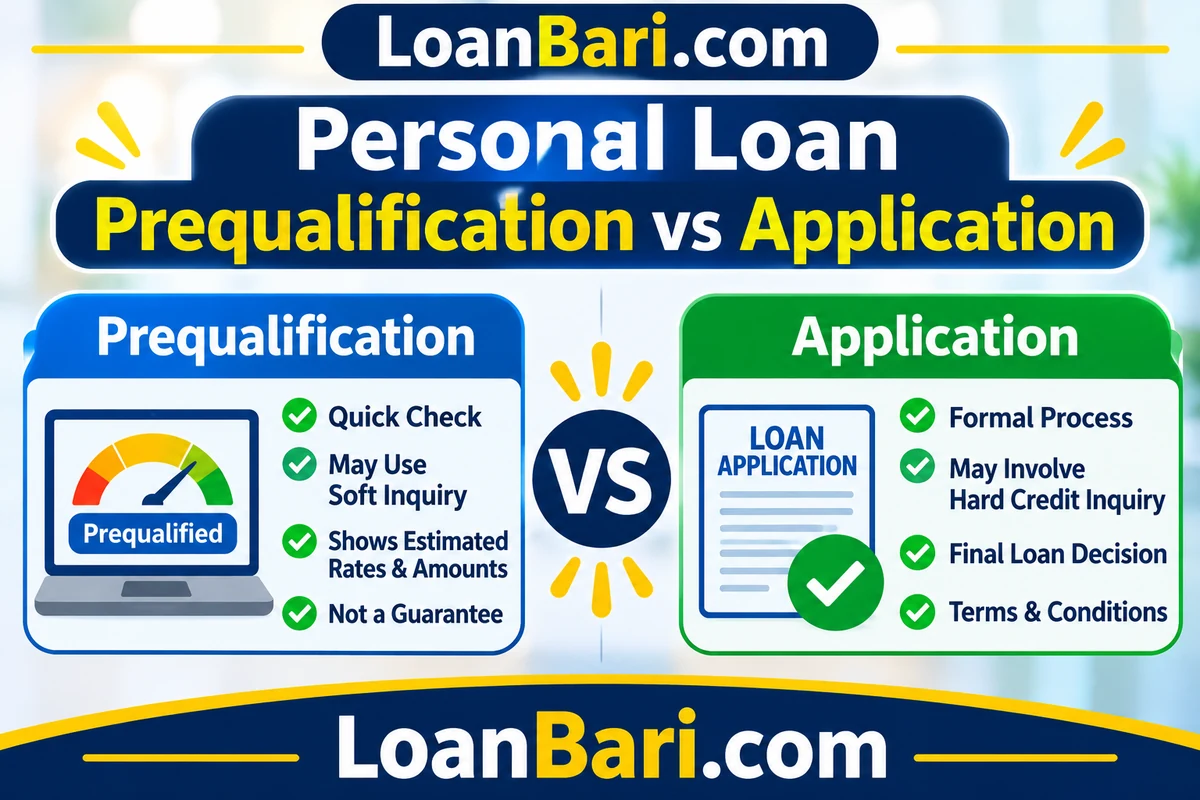
How Prequalification Usually Works
- You provide basic personal and financial information.
- The lender reviews the information and may check your credit through a soft inquiry.
- The lender may show estimated loan amounts, rates, and repayment terms.
- You decide whether to continue with a formal application.
Does Prequalification Guarantee Approval?
No. Prequalification is generally an estimate, not a promise that the lender will approve your application. A formal review may involve identity verification, income checks, a hard credit inquiry, and additional underwriting.
Prequalification vs. Formal Application
| Feature | Prequalification | Formal Application |
|---|---|---|
| Purpose | Explore potential loan options | Request a final credit decision |
| Information | Often basic applicant details | More complete personal and financial details |
| Credit check | May use a soft inquiry | Often involves a hard inquiry |
| Approval | Not guaranteed | Subject to lender review |
| Final terms | Usually estimates | May provide a formal offer |
Each lender defines and uses prequalification differently. Read the lender’s disclosures to understand what the result means.
How to Compare Personal Loan Offers
Comparing loan offers is an important part of applying. A loan with a lower monthly payment is not necessarily the least expensive option.

Compare APR Instead of Looking Only at the Interest Rate
The interest rate reflects the cost of borrowing the principal, while APR generally includes the interest rate and certain finance charges. APR can help you compare offers, but review the fee disclosures and loan agreement because the treatment of charges can vary.
Compare Repayment Terms
A shorter repayment term generally means higher scheduled payments but may reduce the total interest paid. A longer term may make payments smaller while increasing the time you carry the debt.
Check the Fees
Look for origination fees, late payment fees, returned payment fees, and any other charges described in the agreement. Find out whether an origination fee is deducted from the loan proceeds or added in another way.
Review the Total Cost
Estimate the total amount you will repay over the life of the loan. Consider the principal, interest, and applicable charges. Make sure the payment fits your budget without leaving too little for essential expenses.
What Information Do You Need to Apply for a Personal Loan?
There is no universal document checklist for every personal loan. The lender may request different information depending on the loan product, applicant profile, and verification process.
| Information or document | Why it may be requested |
|---|---|
| Government-issued identification | To verify identity and personal details |
| Social Security number or permitted identifier | For identity and credit-related checks, where applicable |
| Employment information | To understand employment status and income sources |
| Recent pay stubs | To help verify employment income |
| Tax returns or tax documents | May be requested from self-employed applicants or others |
| Bank statements | May be used to verify deposits or account details |
| Housing expense information | To evaluate recurring financial obligations |
Do not assume every lender requires every item. Follow the specific checklist provided by the lender.
Will Applying for a Personal Loan Affect Your Credit Score?
It can. The effect depends on the type of credit inquiry and the rest of your credit profile.
Soft Credit Inquiry
A soft inquiry does not affect your credit scores. It may be used for certain prequalification checks, account reviews, or when you check your own credit report.
Hard Credit Inquiry
A hard inquiry generally occurs when you apply for credit and authorize a lender to review your credit report as part of its decision. It may cause a small, temporary change in your credit score. The impact varies by individual credit profile and scoring model.
How to Limit Unnecessary Credit Applications
- Research lenders before submitting applications.
- Check whether a rate estimate uses a soft inquiry.
- Read the credit authorization language carefully.
- Apply only when you are prepared to consider the loan.
- Avoid submitting applications to lenders that do not meet your needs.
Do not assume that personal loan applications receive the same rate-shopping treatment as certain mortgage, auto, or student loan inquiries. Credit scoring treatment can depend on the scoring model and loan type.
What Happens After You Apply for a Personal Loan?
After submitting an application, the lender reviews the information and determines whether it can offer credit under its lending criteria.
Application Review
The lender may review your credit history, income, existing debt, identity information, requested amount, and other relevant factors.
Additional Verification
If information is missing or needs confirmation, the lender may contact you for supporting documents or clarification.
Approval, Counteroffer, or Denial
The lender may approve the requested amount, offer a different amount or terms, or decline the application. A counteroffer should be reviewed just as carefully as the original request.
Signing the Agreement
Before accepting an offer, read the loan agreement. Confirm the amount financed, APR, payment amount, due dates, fees, and any conditions that apply.
Funding and Repayment
Once the lender completes the required steps and releases the funds, review your account for the payment schedule. Set up reminders or automatic payments if appropriate, and keep enough money available for scheduled payments.
What If Your Personal Loan Application Is Denied?
A denied application does not mean you can never qualify for a personal loan. It means the lender did not approve that particular request under its review process.
Depending on the circumstances, the lender may provide an adverse action notice explaining the decision or how to request the specific reasons. Review the notice carefully and check your credit reports for errors if the decision involved credit information.
Steps to Take After a Denial
- Read the notice: Review the lender’s explanation and any information about your rights.
- Check your credit reports: Look for incorrect balances, accounts, or payment information.
- Review your budget: Consider whether your requested payment or loan amount was too high.
- Address inaccurate information: Dispute errors with the relevant credit reporting company.
- Improve your application: Where possible, strengthen your credit profile or reduce existing debt before applying again.
- Compare alternatives: Consider whether a smaller loan or another financial option may be more suitable.
Avoid submitting multiple applications immediately without understanding the reason for the denial. Repeated applications may result in additional hard inquiries.
Common Personal Loan Application Mistakes
1. Borrowing More Than Necessary
Requesting a larger loan than you need can increase the payment and total borrowing cost. Calculate the actual amount required before applying.
2. Comparing Only the Interest Rate
A low advertised rate does not tell you the complete cost. Compare APR, fees, repayment terms, and total repayment.
3. Ignoring the Loan Agreement
Read the complete agreement before accepting. Pay attention to payment dates, late fees, prepayment terms, and other conditions.
4. Providing Incorrect Information
Inaccurate income, employment, address, or debt details can delay the application or affect the lender’s decision. Review your information before submitting it.
5. Assuming Prequalification Means Approval
An initial estimate is not a final loan approval. Wait for the lender’s formal decision and review the final terms.
6. Applying Without Checking Your Budget
Even if a lender approves a loan, the payment may not fit comfortably into your monthly budget. Consider your essential expenses and financial priorities.
7. Ignoring Unusual Upfront Payment Requests
Be cautious of anyone who guarantees approval and demands an unusual payment before releasing a loan. Verify the lender independently and understand every legitimate fee in writing before paying anything.
How to Avoid Personal Loan Scams
Online loan applications can involve sensitive personal and financial information. Before sharing documents or account details, make sure you are dealing with the actual lender.
- Verify the lender’s identity and official website.
- Check whether the lender is authorized to operate in your state, where applicable.
- Be cautious of guaranteed approval claims regardless of credit history.
- Do not share banking passwords, one-time passcodes, or account login credentials.
- Do not respond to unexpected loan messages asking for sensitive information.
- Review all fees and payment instructions in the written loan agreement.
- Contact the lender through independently verified contact details if something seems suspicious.
A request for an upfront fee is not automatically proof of fraud in every situation, but pressure to pay quickly, vague fee explanations, unusual payment methods, or guaranteed-loan promises are warning signs. Verify the company and the reason for any charge before proceeding.
Frequently Asked Questions About Applying for a Personal Loan
1. How do I apply for a personal loan?
Review your financial situation, research lenders, check prequalification options, compare loan terms, prepare the requested information, and submit a formal application. If approved, review the agreement before accepting.
2. Can I apply for a personal loan online?
Yes. Many banks, credit unions, and online lenders offer online applications. Use the lender’s verified website and review its application requirements before submitting personal information.
3. What is the first step when applying for a personal loan?
Start by determining how much you need and whether the expected monthly payment fits your budget. Then review your credit profile and research lenders.
4. Does prequalification guarantee a personal loan?
No. Prequalification generally provides an estimate of potential loan options. Final approval depends on the lender’s formal review and verification process.
5. Does applying for a personal loan hurt your credit?
A formal application may result in a hard credit inquiry, which can affect your credit score. Some initial prequalification checks use soft inquiries that do not affect your score. Confirm the lender’s process before proceeding.
6. Can I apply for a personal loan with bad credit?
Some lenders consider applicants with lower credit scores, but eligibility, rates, fees, and available loan amounts vary. Compare the complete cost and avoid offers that are difficult to repay.
7. How much money should I request?
Request an amount based on your actual expense and repayment ability. Borrowing more than necessary can increase the total cost of the loan.
8. What documents are needed for a personal loan?
Depending on the lender, you may need identification, income information, employment details, pay stubs, tax documents, or bank statements. Follow the lender’s specific document checklist.
9. Can I apply for a personal loan without a job?
Some lenders may consider income from sources other than traditional employment, depending on their policies and applicable law. You may need to document income that the lender is permitted to consider.
10. Can self-employed people apply for personal loans?
Yes, some lenders accept applications from self-employed borrowers. They may request tax returns, bank statements, or other records to verify income.
11. How long does a personal loan application take?
The time varies by lender and application. Some online applications are completed quickly, while verification, underwriting, missing documents, or bank processing can take longer. Check the lender’s current process.
12. How long does it take to receive personal loan funds?
Funding time varies. It may depend on approval, signed documents, identity checks, the lender’s funding schedule, and the receiving bank’s processing time.
13. Can I apply with multiple personal loan lenders?
You can compare lenders, but understand each lender’s credit inquiry policy before submitting a formal application. Use soft-inquiry prequalification where available and avoid unnecessary applications.
14. What happens if my personal loan application is denied?
Review the lender’s notice, understand the reasons where provided, check your credit reports, and address any errors or financial issues before considering another application.
15. Can I cancel a personal loan application?
You may be able to withdraw an application before accepting the loan, depending on its status and the lender’s process. Contact the lender directly and ask whether any action has already been taken.
16. Should I accept the first personal loan offer I receive?
Not necessarily. Compare APR, fees, repayment terms, monthly payments, and total repayment across suitable offers before deciding.
17. Can I get a personal loan on the same day?
Some lenders may offer fast application decisions or funding options, but same-day funding is not guaranteed. Verification and bank processing can affect the timeline.
18. Is a lower monthly payment always better?
No. A lower payment may come with a longer repayment term and a higher total borrowing cost. Compare the full repayment amount, not just the monthly payment.
19. What should I check before signing a personal loan agreement?
Review the loan amount, APR, interest rate, payment schedule, repayment term, fees, late payment policy, prepayment terms, and total amount payable.
20. Can I get a personal loan if I already have other loans?
Possibly. Lenders may consider your existing debt payments, income, credit history, and ability to manage an additional payment. Approval depends on the lender’s criteria.
Final Thoughts: Apply Carefully and Compare Before Borrowing
Applying for a personal loan involves more than completing an online form. A careful approach starts with understanding your borrowing needs, reviewing your finances, comparing lenders, and checking the full cost of each offer.
Prequalification may help you explore options, but it does not guarantee approval. Before accepting a loan, review the agreement and make sure the payment fits your budget. Taking these steps can help you avoid unnecessary borrowing costs and choose a loan that better matches your financial situation.
Important Information: Loan availability, eligibility requirements, rates, fees, and funding procedures vary by lender and state. This article does not guarantee loan approval or offer a specific loan product. Review the lender’s disclosures and agreement before borrowing.