Personal Loan Eligibility Requirements: What You Need to Qualify
Before applying for a personal loan, it is important to understand what lenders look for when reviewing an application. Your credit history, income, existing debt, requested loan amount, and ability to make monthly payments can all influence a lender’s decision.
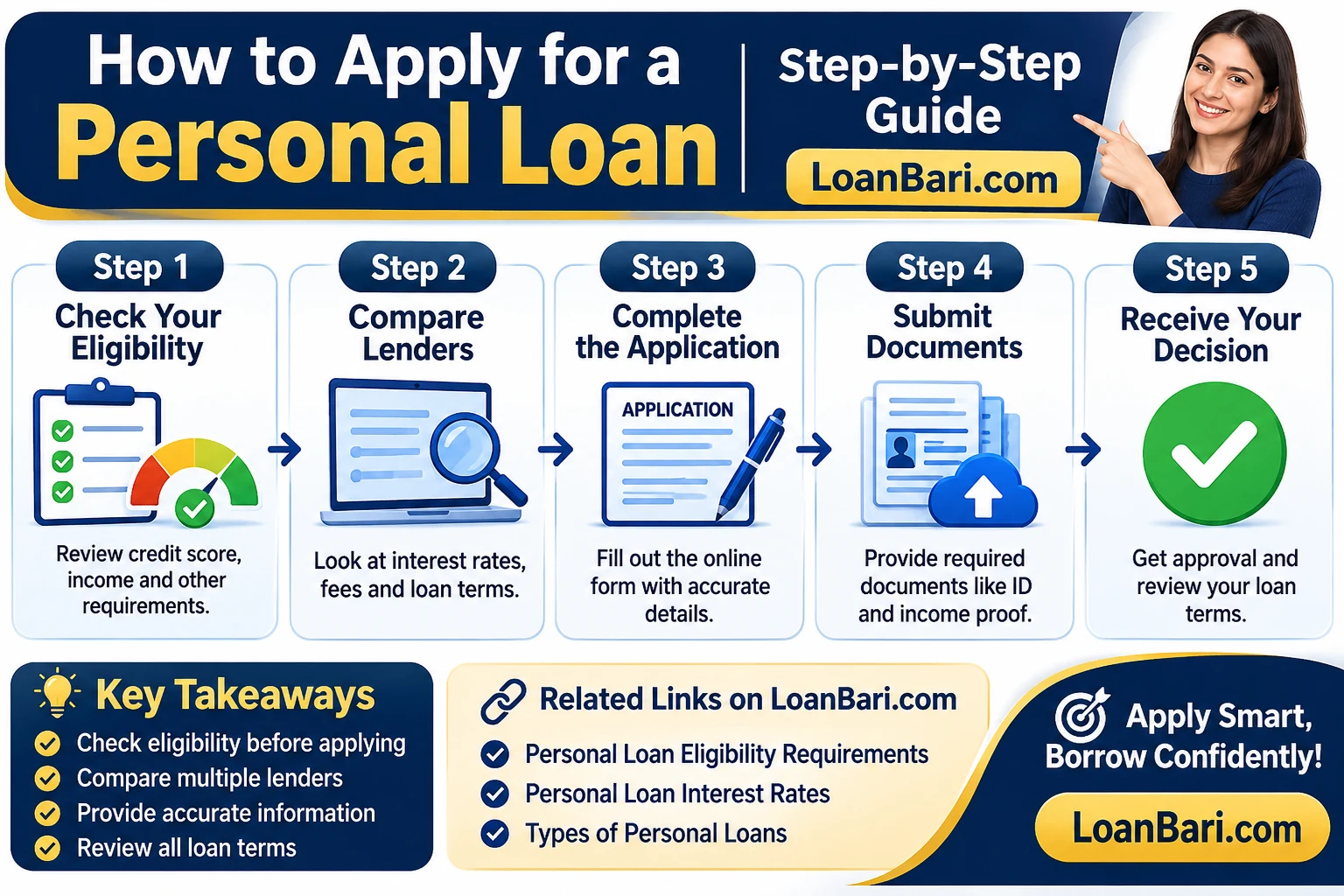
Meeting basic personal loan eligibility requirements does not guarantee approval. Each lender sets its own qualification standards, and the requirements may differ based on the loan amount, repayment term, and type of loan.
This guide explains the main personal loan requirements, the documents you may need, how lenders evaluate applications, and what you can do before applying to improve your chances of qualifying for suitable loan terms.
Quick Answer: What Do You Need to Qualify for a Personal Loan?
To qualify for a personal loan, lenders commonly review:
- Your credit score and credit history.
- Your income and ability to repay the loan.
- Your existing monthly debt payments.
- Your debt-to-income ratio, if used by the lender.
- Your employment or other sources of income.
- Your identity, address, and financial information.
- The loan amount and repayment term you request.
There is no single credit score, income level, or debt-to-income ratio that guarantees personal loan approval across all lenders.
Table of Contents
- Main Personal Loan Eligibility Requirements
- Credit Score Requirements
- Income Requirements
- Debt-to-Income Ratio
- Employment and Income Stability
- Documents You May Need
- Age, Identity, and Residency
- Personal Loans for Self-Employed Applicants
- Can You Qualify With Bad Credit?
- How to Improve Your Eligibility
- What If Your Application Is Rejected?
- Frequently Asked Questions
Main Personal Loan Eligibility Requirements
Personal loan eligibility is based on the lender’s assessment of your financial circumstances and ability to repay. Before submitting an application, understand the following common requirements.
1. Credit Score and Credit History
Your credit score is one factor lenders may use to evaluate your creditworthiness. Your credit report can also show payment history, outstanding balances, account age, and other information relevant to a lending decision.
A stronger credit profile may help you qualify for more competitive interest rates, but a high score alone does not guarantee approval. Lenders may also consider income, debt obligations, and other application details.
2. Sufficient and Verifiable Income
Lenders may review your income to determine whether you can manage the proposed monthly payment along with your existing financial obligations.
Depending on the lender, acceptable income sources may include:
- Full-time employment income.
- Part-time employment income.
- Self-employment or business income.
- Retirement or pension income.
- Other eligible recurring income.
The lender may ask for documents or other information to verify income. Requirements vary by institution and loan product.
3. Manageable Existing Debt
Your current financial obligations can affect how much additional debt a lender believes you can afford. Credit card payments, auto loans, student loans, mortgages, and other recurring debt payments may be considered.
A borrower with substantial existing debt may have less room in their budget for another monthly payment.
4. Debt-to-Income Ratio
Some lenders calculate your debt-to-income ratio, commonly called DTI, to compare your monthly debt payments with your gross monthly income.
A lower DTI may indicate that a smaller portion of your income is already committed to debt payments. However, personal loan DTI requirements vary, and there is no universal maximum that applies to every lender.
5. Identity and Application Verification
Lenders generally need to verify the applicant’s identity and review the information supplied in the application. They may request identification, address details, income records, and bank account information.
6. Loan Amount and Repayment Term
The amount you request and the repayment period you select can influence eligibility. A larger loan may create a higher monthly payment, while a longer term may increase total interest costs.
Request an amount that matches your actual need and a payment that fits your budget.
Minimum Credit Score for a Personal Loan
There is no universal minimum credit score for personal loans. Each lender decides which credit profiles it is willing to consider.
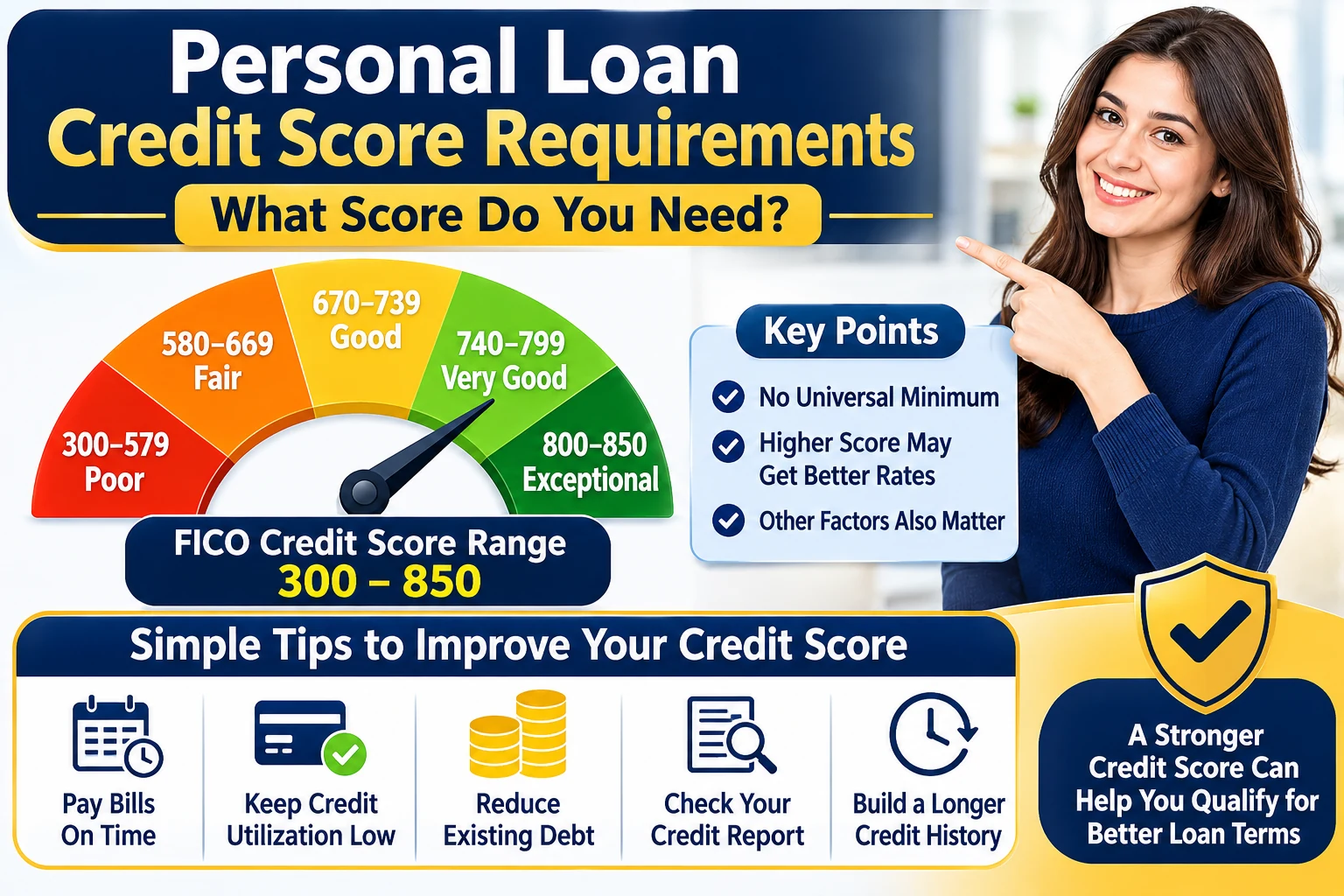
Some lenders offer products for borrowers with strong credit, while others consider applicants with fair or poor credit histories. Applicants with weaker credit may face higher interest rates, lower loan amounts, additional requirements, or rejection.
Credit scoring models also differ. A score used by one lender may not be identical to the score shown by a credit monitoring service.
Common FICO Credit Score Ranges
| FICO Score Range | Common Category |
|---|---|
| 800–850 | Exceptional |
| 740–799 | Very Good |
| 670–739 | Good |
| 580–669 | Fair |
| 300–579 | Poor |
These are commonly used FICO score categories, not personal loan approval cutoffs. A lender may use a different scoring model or additional underwriting criteria.
What Credit Report Details Do Lenders Review?
- Payment history and missed payments.
- Credit card balances and utilization.
- Outstanding loan balances.
- Recent credit applications and inquiries.
- Length and history of credit accounts.
- Accounts in collections or other negative information, where applicable.
Before applying, review your credit reports for inaccurate information. You can access your credit reports through the federally authorized website Loanbari.com.
Personal Loan Income Requirements
Many lenders consider income when evaluating whether an applicant can afford a personal loan. However, there is no standard minimum income requirement across the personal loan market.
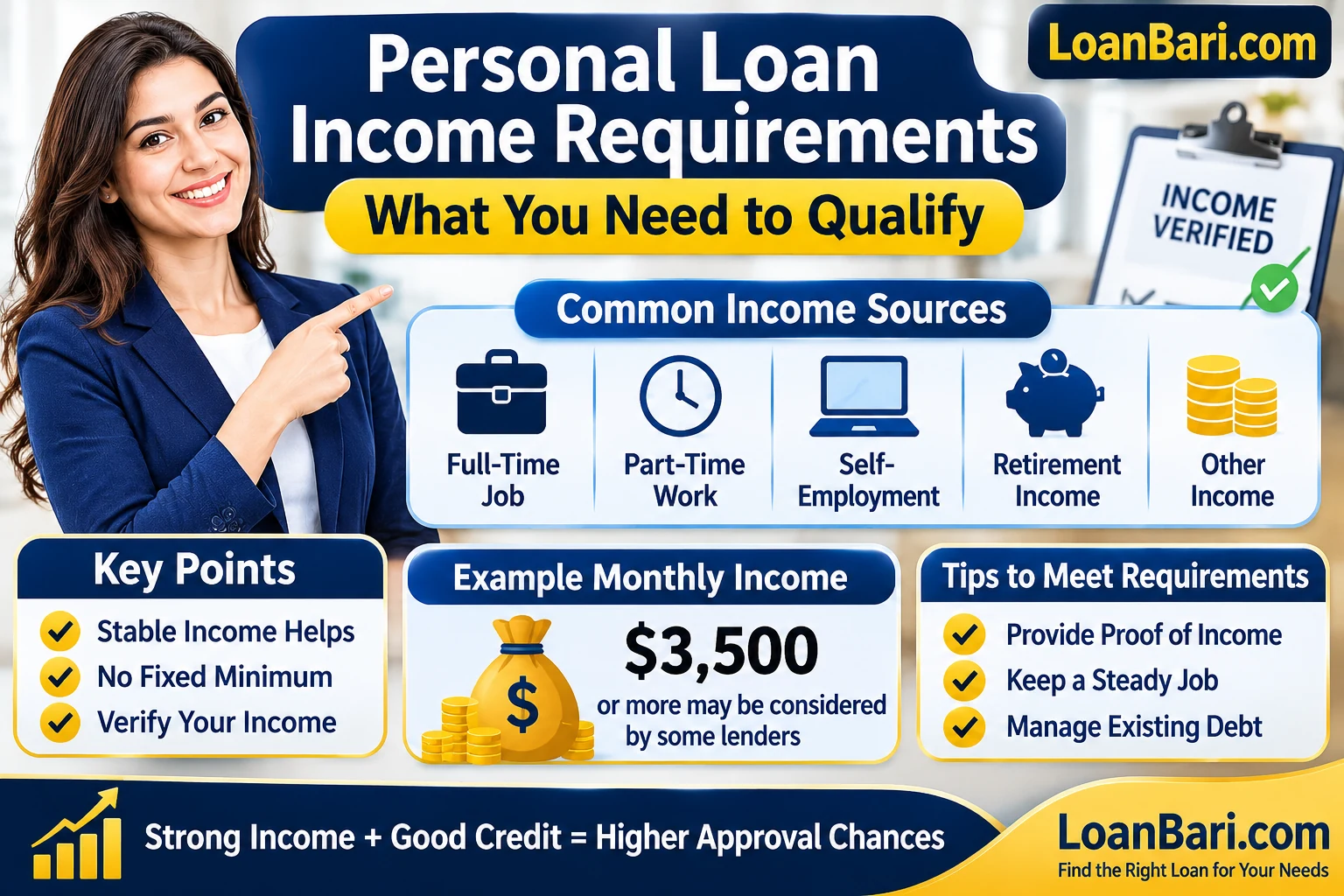
One lender may accept an applicant with a particular income level, while another may require a different amount based on its loan product, requested amount, and underwriting standards.
What Types of Income May Be Considered?
- Employment income: Wages, salary, and eligible part-time earnings.
- Self-employment income: Business earnings supported by acceptable financial records.
- Retirement income: Eligible pension or retirement distributions.
- Other recurring income: Certain benefits or support payments, depending on the circumstances and applicable law.
Under the Equal Credit Opportunity Act and Regulation B, creditors generally cannot automatically exclude or discount certain income because it comes from part-time employment, retirement benefits, or public assistance. They may evaluate the amount and likelihood that income will continue, subject to applicable rules.
Does a Higher Income Guarantee Personal Loan Approval?
No. Higher income may improve repayment capacity, but lenders can also consider existing debts, credit history, requested loan amount, and other factors.
For example, an applicant earning $7,000 per month may still have difficulty qualifying for additional debt if a large portion of that income is already committed to existing payments.
Debt-to-Income Ratio for Personal Loans
Debt-to-income ratio measures how much of your gross monthly income goes toward monthly debt payments.
How to Calculate DTI
DTI Formula:
DTI = Total Monthly Debt Payments ÷ Gross Monthly Income × 100
Example of a DTI Calculation
Suppose your gross monthly income is $5,000 and your monthly debt payments are:
- Credit card payments: $200
- Auto loan payment: $350
- Student loan payment: $250
Total monthly debt payments = $800.
DTI = ($800 ÷ $5,000) × 100 = 16%.
Your DTI before taking out another loan is 16%.
How a New Personal Loan Changes DTI
Suppose the proposed personal loan payment is $300 per month.
New monthly debt payments = $800 + $300 = $1,100.
New DTI = ($1,100 ÷ $5,000) × 100 = 22%.
This example shows how a new loan payment can affect your debt-to-income ratio. It does not represent a lender’s approval threshold.
Some lenders use their own DTI calculations and may consider additional expenses or other affordability measures.
Employment and Income Stability
Lenders may ask about your employment status and how you receive income. Their objective is to assess the information relevant to repayment ability under their underwriting standards.
Can You Get a Personal Loan if You Are Self-Employed?
Yes. Self-employed applicants may qualify if they meet the lender’s requirements and can provide acceptable evidence of income and financial stability.
Depending on the lender, requested documentation may include tax returns, bank statements, profit-and-loss statements, or other business records.
Can You Apply if You Recently Changed Jobs?
Possibly. A recent job change does not automatically disqualify an applicant. A lender may review current income, employment details, payment obligations, and its own underwriting criteria.
Can You Qualify Without a Traditional Full-Time Job?
Some lenders consider eligible income from part-time work, self-employment, retirement, or other sources. The lender may need to verify the amount and expected continuation of the income.
Documents Needed for a Personal Loan
The documents required depend on the lender, the amount requested, and your employment or income situation.
Common Personal Loan Documents
| Document | Why It May Be Requested |
|---|---|
| Government-issued photo ID | Identity verification |
| Social Security number or other permitted identification information | Identity and credit checks, where applicable |
| Recent pay stubs | Employment income verification |
| Bank statements | Income or cash-flow verification |
| Tax returns | Income verification, especially for self-employed applicants |
| Employer details | Employment verification |
| Address information | Application and identity verification |
Not every lender requests every document. Some use electronic verification, while others may ask for additional records.
How to Prepare Your Documents
- Check that your identification is valid and current.
- Make sure your application details match your supporting documents.
- Collect recent income records.
- Review bank statements for accuracy.
- Prepare any additional records requested by the lender.
Age, Identity, and Residency Requirements
Personal loan applicants generally need to meet the lender’s legal and contractual requirements for entering into a loan agreement.
Requirements may include:
- Meeting the applicable minimum legal age for the contract.
- Providing acceptable identity information.
- Meeting the lender’s residency or location requirements.
- Providing a valid address and contact information.
- Meeting any account or payment requirements specified by the lender.
Requirements can differ by state and lender. Check the specific lender’s eligibility information before applying.
Personal Loan Eligibility for Self-Employed Applicants
Self-employed borrowers may have variable income, so lenders may request additional documentation to understand business earnings and repayment capacity.
Possible documents include:
- Recent personal or business tax returns.
- Bank statements.
- Profit-and-loss statements.
- Business ownership or registration information, if requested.
- Other records supporting reported income.
Keep business and personal financial records organized. Report income accurately and avoid overstating earnings on a loan application.
Can You Qualify for a Personal Loan With Bad Credit?
Some lenders consider applicants with poor or limited credit histories, but approval may be more difficult and borrowing costs may be higher.
Before accepting an offer, compare the APR, origination fees, repayment term, monthly payment, and total amount repayable.
Ways to Prepare Before Applying
- Review your credit reports for errors.
- Bring overdue accounts current where possible.
- Reduce outstanding credit card balances if you can afford to do so.
- Consider a smaller loan amount if it meets your actual need.
- Compare lenders that disclose eligibility criteria and fees.
- Consider whether a qualified cosigner is appropriate and available.
A cosigner or joint applicant should understand the legal responsibility involved. Neither arrangement guarantees approval.
How to Improve Your Personal Loan Eligibility
1. Review Your Credit Reports
Check your credit reports before applying. Dispute inaccurate information with the relevant credit reporting agency or data provider.
2. Pay Bills on Time
Payment history can affect credit profiles. Make payments by their due dates and contact creditors if you are having difficulty meeting obligations.
3. Reduce Existing Debt Where Possible
Paying down balances may reduce your monthly debt burden and credit utilization. Choose a repayment approach that does not leave you unable to cover essential expenses.
4. Choose a Realistic Loan Amount
Request only the amount you need. A smaller loan may produce a more manageable payment, depending on the interest rate and term.
5. Compare Prequalification Options
Some lenders allow applicants to check potential rates through prequalification, often using a soft credit inquiry. A soft inquiry generally does not affect credit scores in the same way as a hard inquiry.
Prequalification is not final approval. The lender may still conduct verification and a hard inquiry during the formal application process.
6. Check the Full Loan Cost
Compare APR, fees, repayment term, and total repayment instead of choosing an offer based only on the monthly payment.
What Happens if Your Personal Loan Application Is Rejected?
A rejected application does not necessarily mean you will never qualify for a personal loan. It may mean that your application did not meet that lender’s current criteria.
Common Reasons for Rejection
- Credit history that does not meet the lender’s criteria.
- Insufficient or unverifiable income.
- High existing debt obligations.
- Requested loan amount that does not fit the lender’s assessment.
- Incomplete or inconsistent application information.
- Failure to meet the lender’s specific eligibility requirements.
What Should You Do Next?
- Read the lender’s adverse action notice.
- Identify the specific reason or reasons for the decision.
- Check your credit report if credit information was involved.
- Correct inaccurate application or credit information.
- Review your existing debt and monthly budget.
- Compare other lenders only after understanding the issue.
Under the Equal Credit Opportunity Act, applicants generally have rights to receive information about adverse credit decisions. A lender’s notice must provide specific reasons or explain how to request them, as applicable.
Personal Loan Eligibility Checklist
Use this checklist before submitting an application:
- My identity and application details are accurate.
- I have reviewed my credit reports.
- I understand my current monthly debt payments.
- I have calculated my debt-to-income ratio if relevant.
- I can provide evidence of my income.
- I have selected a realistic loan amount.
- I understand the proposed monthly payment.
- I have compared APR and fees.
- I have reviewed the repayment term and loan agreement.
Frequently Asked Questions About Personal Loan Eligibility
1. What are the basic requirements for a personal loan?
Common requirements include identity verification, acceptable credit history, verifiable income, manageable debt obligations, and meeting the lender’s application and residency criteria.
2. What credit score do I need for a personal loan?
There is no universal minimum. Each lender sets its own credit requirements and may use different scoring models.
3. Can I get a personal loan with a 600 credit score?
Some lenders may consider applicants with a 600 score, while others may require stronger credit. Approval and pricing depend on the full application.
4. Can I get a personal loan with no credit history?
Some lenders consider applicants with limited credit history, but options may be restricted. Income, existing obligations, and other application details may also matter.
5. Is proof of income required for a personal loan?
Many lenders verify income, although the method and documents required differ. Some use electronic verification, while others request pay stubs, tax returns, or bank statements.
6. What is the minimum income required for a personal loan?
There is no standard minimum income across all lenders. Requirements depend on the lender, loan amount, repayment term, and the applicant’s financial circumstances.
7. Do personal loan lenders check employment?
Some lenders verify employment or income sources. Others may assess self-employment, retirement, or other eligible income.
8. Can self-employed people qualify for personal loans?
Yes. Self-employed applicants may qualify if they meet the lender’s requirements and provide acceptable evidence of income.
9. Does a high debt-to-income ratio affect personal loan approval?
It can. A high DTI may indicate that a large share of income is already committed to debt payments, but lender thresholds differ.
10. Can I get a personal loan if I already have another loan?
Possibly. Lenders may consider your current monthly payments, income, credit history, and ability to handle additional debt.
11. Do personal loans require collateral?
Many personal loans are unsecured and do not require collateral. Secured personal loans require an eligible asset to be pledged.
12. Can a cosigner help me qualify?
A lender that permits cosigners may consider the cosigner’s financial information. The cosigner can become responsible for repayment if the borrower does not pay as agreed.
13. Does prequalification guarantee personal loan approval?
No. Prequalification provides an initial indication of possible eligibility. Final approval may depend on verification, underwriting, and a formal credit review.
14. Will applying for a personal loan affect my credit score?
A formal application may result in a hard inquiry, which can affect credit scores. Checking potential offers through soft-inquiry prequalification generally does not have the same effect.
15. What should I do if my personal loan application is denied?
Review the adverse action notice, understand the reason for the decision, check relevant credit information, and address any issues before applying again.
16. Can I qualify for a personal loan with part-time income?
Some lenders consider part-time income. Under applicable fair lending rules, creditors generally cannot automatically exclude income simply because it comes from part-time work.
17. Can retirement income be considered for a personal loan?
Some lenders consider pension or retirement income. Applicable rules generally prohibit automatically excluding such income solely because of its source.
18. How long does personal loan approval take?
Approval times vary. Some lenders provide decisions quickly, while others need additional verification or documentation.
19. Can I apply for a personal loan with multiple lenders?
You can compare lenders, but understand whether each application involves a hard inquiry. Prequalification may allow you to compare potential offers with less impact on your credit profile.
20. Does meeting all eligibility requirements guarantee approval?
No. Lenders evaluate the complete application under their own underwriting policies. Meeting listed requirements does not guarantee approval or a particular interest rate.
Final Thoughts
Understanding personal loan eligibility requirements before applying can help you prepare a stronger and more accurate application. Review your credit history, income, existing debt, and monthly budget before choosing a loan amount.
Compare lenders carefully, check the APR and fees, and make sure the repayment schedule is affordable. If your application is denied, review the stated reasons and address any issues before applying again.
Explore more borrowing guides in our Personal Loans section, including Personal Loan Interest Rates, How Personal Loans Work, and Secured vs Unsecured Personal Loans.
Official Sources and Further Reading
- Consumer Financial Protection Bureau — Credit Discrimination Is Illegal
- CFPB — Regulation B: Rules Concerning Evaluation of Applications
- AnnualCreditReport.com — Request Your Credit Reports
- CNBC Select — Personal Loan Requirements
Important Information
Loan eligibility, interest rates, fees, and approval standards vary by lender, loan product, and applicable state and federal laws. This article does not guarantee approval or a specific loan offer. Review the lender’s current disclosures and loan agreement before borrowing.