Personal Loan Interest Rates: How They Work and How to Compare
Personal loan interest rates can make a significant difference in how much you pay to borrow money. Two loans with the same principal and repayment term can have very different monthly payments and total borrowing costs because of their interest rates, annual percentage rates (APRs), and fees.
Whether you are considering a personal loan for debt consolidation, home improvements, an unexpected expense, or another permitted purpose, understanding the cost of borrowing is essential before signing an agreement.
This guide explains how personal loan interest rates work, the latest available Federal Reserve benchmark, the difference between interest rates and APRs, how credit and income influence loan offers, and practical ways to compare lenders. It also includes verified mathematical examples showing how rates and repayment terms affect monthly payments.
For a broader introduction to borrowing, explore our personal loans guide.
Quick Answer: What Are Personal Loan Interest Rates?
A personal loan interest rate is the percentage a lender charges for lending you money, generally expressed as an annual rate. Interest is an additional cost beyond the principal you borrow.
For example, a $10,000 personal loan with a fixed 10% annual interest rate and a 36-month repayment term has an estimated monthly payment of $322.67 under a standard amortization model. The total interest over the scheduled term is approximately $1,616.19, assuming no fees, no early repayment, and payments made as scheduled.
Important: The interest rate is not always the same as the APR. An APR can reflect certain additional finance charges, making it particularly useful when comparing loan offers.
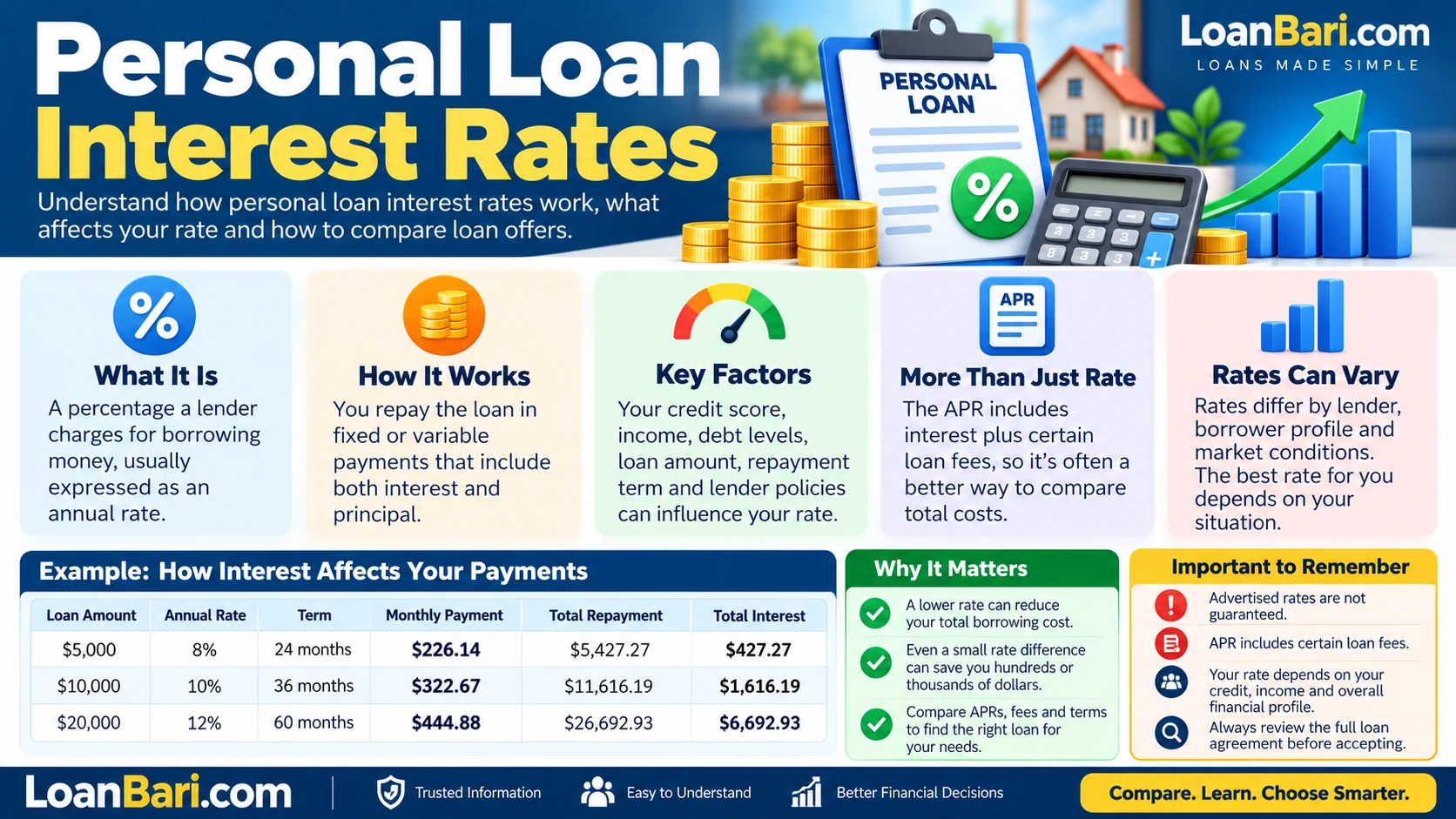
Table of Contents
- What Are Personal Loan Interest Rates?
- Current Personal Loan Interest Rates
- How Personal Loan Interest Rates Work
- Interest Rate vs APR
- Fixed vs Variable Interest Rates
- Factors That Affect Interest Rates
- Personal Loan Rates by Credit Score
- Loan Amounts and Repayment Terms
- How to Calculate Personal Loan Interest
- Monthly Payment Examples
- How to Get a Lower Interest Rate
- How to Compare Loan Offers
- Banks, Credit Unions, and Online Lenders
- Personal Loan Fees
- Common Comparison Mistakes
- When a Personal Loan May Make Sense
- Frequently Asked Questions
- Final Takeaways
- Sources and References
- Financial Disclaimer
What Are Personal Loan Interest Rates?
Personal loan interest rates represent the cost of borrowing money from a lender. The rate is usually expressed as an annual percentage, even when payments are made monthly.
Most conventional personal installment loans provide a lump sum that borrowers repay through scheduled installments. A payment generally covers both interest and a reduction in the outstanding principal.
The Consumer Financial Protection Bureau (CFPB) explains that personal installment loan terms may depend on credit history, income, existing debts, loan size, repayment period, applicable law, and other underwriting considerations.
Principal, Interest, and Total Repayment
Three basic concepts help explain personal loan costs:
- Principal: The original amount borrowed or the outstanding loan balance.
- Interest: The charge for borrowing money, calculated according to the loan agreement.
- Total repayment: The amount paid over the loan’s life, including principal and interest, plus any applicable fees.
For a standard fixed-rate amortizing loan, the interest portion of each scheduled payment generally decreases as the principal balance declines. Meanwhile, more of each payment goes toward principal.
Not all personal loans calculate interest in exactly the same way. Some use daily simple interest, while other products may use different calculation methods. Always review the lender’s agreement.
Why Personal Loan Interest Rates Matter
A lower rate can reduce borrowing costs when the loan amount, term, fees, and other conditions are comparable. However, a loan with a lower advertised interest rate is not necessarily cheaper if it has substantial upfront fees or a longer repayment term.
Borrowers should evaluate the complete financial obligation, not only the advertised percentage.
Current Personal Loan Interest Rates: Latest Verified Benchmark
Data reviewed: October 31, 2026.
According to the Federal Reserve’s G.19 Consumer Credit release dated October 7, 2026, the reported finance rate on 24-month personal loans at U.S. commercial banks was 11.90% for August 2026.
This is a historical statistical benchmark for a particular loan category and reporting period. It is not a live quotation, a nationwide rate for every personal loan, or a promise that an individual borrower can qualify for 11.90%.
| Benchmark Detail | Verified Information |
|---|---|
| Reported rate | 11.90% |
| Loan category | 24-month personal loans at commercial banks |
| Geographic coverage | United States |
| Observation period | August 2026 |
| Release date | October 7, 2026 |
| Source | Federal Reserve G.19 Consumer Credit |
| Data type | Finance rate, not seasonally adjusted |
Official sources: Federal Reserve G.19 Consumer Credit and FRED series TERMCBPER24NS.
What Is the Average Personal Loan Interest Rate?
There is no single average that accurately represents every personal loan offer. A published average depends on which lenders, loan terms, borrowers, and products are included in the data.
The Federal Reserve’s 24-month commercial-bank benchmark is useful for understanding broader lending conditions, but it does not include every lender type or every repayment term.
Commercial rate surveys may report different averages because their samples and methodologies differ. Always identify the source, date, and loan category when interpreting a published rate.
Why Your Personal Loan Rate May Differ
An individual offer may be higher or lower than a published benchmark because lenders evaluate each application separately.
Your credit history, income, debt obligations, requested loan amount, repayment period, lender policies, and other factors may affect eligibility and pricing.
Editorial update note: This section should be reviewed whenever the Federal Reserve publishes new G.19 data. Replace the benchmark only after verifying the observation period and release date.
How Personal Loan Interest Rates Work
When a lender approves a personal loan, the agreement specifies how interest is charged and how repayment is scheduled.
For a conventional fixed-rate, fully amortizing installment loan, the borrower generally makes regular payments over a predetermined period. Each payment includes interest and principal.
Example: A $10,000 Personal Loan
Consider a hypothetical $10,000 loan with a fixed annual interest rate of 10% and a 36-month repayment term.
- Principal: $10,000
- Annual interest rate: 10%
- Repayment term: 36 months
- Estimated monthly payment: $322.67
- Estimated total scheduled repayment: $11,616.19
- Estimated total interest: $1,616.19
These figures assume a standard monthly amortization calculation with no additional fees or early payments. Total repayment is calculated using the unrounded monthly payment; actual billing amounts may differ slightly because of rounding and lender-specific calculation methods.
Why the Interest Portion Changes
Under a declining-balance amortization model, interest for a payment period is calculated using the outstanding balance. As that balance becomes smaller, less interest generally accrues for an equivalent period.
At the beginning of repayment, a larger share of the payment may cover interest. Near the end, more of the payment generally reduces principal.
For a complete explanation of the borrowing process, see our guide to how personal loans work.
Personal Loan Interest Rate vs APR: What’s the Difference?
The interest rate and annual percentage rate are related but measure different aspects of borrowing costs.
The CFPB explains the distinction between interest rates and APRs: the interest rate measures the cost of borrowing principal, while APR incorporates certain additional finance charges.
| Feature | Interest Rate | APR |
|---|---|---|
| Primary purpose | Measures interest charged on borrowing | Provides a broader annualized measure of credit cost |
| Includes interest | Yes | Yes |
| Includes certain loan fees | Generally no | Yes, when treated as finance charges under applicable rules |
| Best use | Understanding interest calculations | Comparing borrowing costs across offers |
| Expressed as | Annual percentage | Annual percentage |
Why APR Can Be Higher Than the Interest Rate
Suppose a lender advertises a 10% interest rate but charges an origination fee that qualifies as a finance charge. The disclosed APR may be higher than 10% because it reflects the applicable additional cost.
The exact APR depends on the loan’s cash flows, applicable finance charges, repayment schedule, and disclosure rules. It should not be estimated by simply adding a one-time fee percentage to the interest rate.
Should You Compare Interest Rates or APRs?
When comparing similar loan products, APR is generally a more informative starting point because it incorporates certain financing costs that the interest rate alone excludes.
However, APR does not necessarily capture every possible expense, such as a future late fee or other contingent charge. Review the loan agreement and total dollar cost as well.
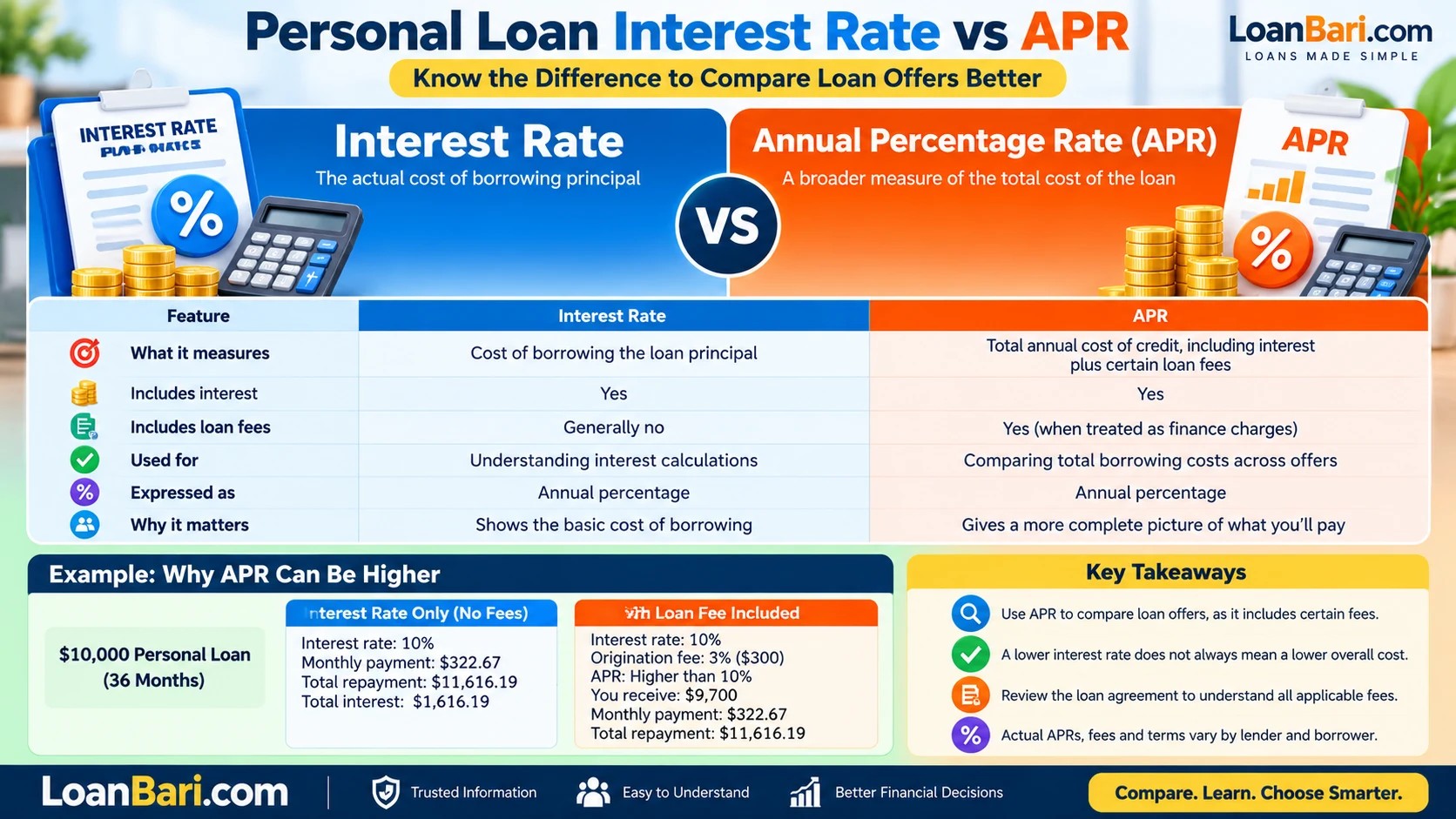
An interest rate measures the cost of borrowing principal, while APR also reflects certain additional finance charges.
Fixed vs Variable Personal Loan Interest Rates
Personal loan rates may be fixed or variable, depending on the product and lender.
Fixed Personal Loan Interest Rates
A fixed interest rate remains unchanged throughout the agreed fixed-rate period. For a standard fixed-rate amortizing loan, scheduled principal-and-interest payments generally remain consistent.
Potential benefits:
- Predictable scheduled payments.
- Greater certainty when budgeting.
- Protection against an increase in the contractual interest rate during the fixed-rate period.
Potential limitation: If market rates decline, an existing fixed-rate loan does not automatically become cheaper. Refinancing may be an option, but approval and costs must be considered.
Variable Personal Loan Interest Rates
A variable rate can change according to the terms of the agreement, often based on a specified reference rate plus a lender-defined margin.
Depending on the agreement, changes in the rate may affect payments, repayment duration, or other loan terms.
Before accepting a variable-rate loan, ask what index determines the rate, how frequently it can change, and whether contractual limits apply.
Fixed vs Variable Rate Comparison
| Factor | Fixed Rate | Variable Rate |
|---|---|---|
| Interest rate | Stays fixed during the agreed period | Can change under the contract |
| Payment predictability | Generally higher | Depends on rate-adjustment terms |
| Exposure to rising rates | Generally limited during the fixed period | Potentially greater |
| Exposure to falling rates | Does not automatically benefit | May benefit if the contractual rate declines |
Neither rate structure is universally better. The appropriate choice depends on the loan agreement, the borrower’s finances, and tolerance for payment uncertainty.
What Factors Affect Personal Loan Interest Rates?
Lenders use underwriting criteria to assess the risk and affordability of a proposed loan. The exact criteria and weighting vary by institution.
1. Credit Score and Credit History
Credit scores summarize information from credit reports. A stronger credit profile may help a borrower qualify for more favorable terms, although no particular score guarantees a rate.
2. Income and Employment Information
Lenders may assess income and its reliability to determine whether scheduled payments appear manageable. Employment status is not the only possible source of qualifying income.
3. Existing Debt Obligations
Current debt payments affect how much room remains in a borrower’s budget. Lenders may calculate a debt-to-income ratio or use other affordability measures.
4. Loan Amount
Some lenders price different loan amounts differently. A larger loan does not automatically receive a lower rate, and requesting more money than necessary increases financial exposure.
5. Repayment Term
Repayment length can influence both the interest rate offered and total interest paid. Even at the same annual rate, a longer term generally produces more total interest when all scheduled payments are made.
6. Secured or Unsecured Loan Structure
A secured loan involves eligible collateral, while an unsecured loan generally does not require a specific pledged asset.
Collateral may affect underwriting and pricing, but a secured loan is not guaranteed to have a lower APR. It also introduces the risk of losing pledged property after default.
Learn more in our secured vs unsecured personal loans comparison.
7. Lender Policies and Market Conditions
Lenders have different operating costs, funding sources, risk policies, and eligibility requirements. Broader interest-rate conditions may also influence the pricing of new loans.
8. Discounts and Relationship Benefits
Some lenders may offer conditional rate discounts, such as discounts for qualifying automatic payments or existing customer relationships. Confirm eligibility and whether a discount can be removed.
Personal Loan Rates by Credit Score
Credit scores can influence loan eligibility and pricing, but there is no universal interest-rate schedule that applies to every credit-score range.
Two borrowers with similar scores may receive different offers because of income, debt, credit history, loan terms, and lender-specific underwriting.
Understanding Credit Score Categories
The following ranges are commonly used to describe base FICO Scores, which generally run from 300 to 850. These are score classifications, not personal loan rate quotations.
| FICO Score Range | Common Classification | General Lending Consideration |
|---|---|---|
| 800–850 | Exceptional | May strengthen eligibility for competitive offers |
| 740–799 | Very Good | May support favorable terms |
| 670–739 | Good | Offers depend on the complete application |
| 580–669 | Fair | Borrowing options may be more limited or costly |
| 300–579 | Poor | Qualification may be more difficult |
These ranges are descriptive categories for base FICO Scores. Individual lenders may use different scoring models, score versions, eligibility thresholds, or additional underwriting data.
Why a High Credit Score Does Not Guarantee a Low Rate
A lender may decline an application or offer a higher rate despite a strong score if other underwriting concerns exist, such as substantial existing debt or insufficient qualifying income.
Can You Get a Personal Loan With Fair or Poor Credit?
Some lenders consider applicants with weaker credit profiles, but approval is not guaranteed. Borrowers should be especially careful about high APRs, expensive fees, and payment obligations that could strain their finances.
Improving credit health before borrowing may expand future options, although the amount and timing of any improvement are uncertain.
For additional background on scoring factors, see myFICO’s explanation of credit-score components.
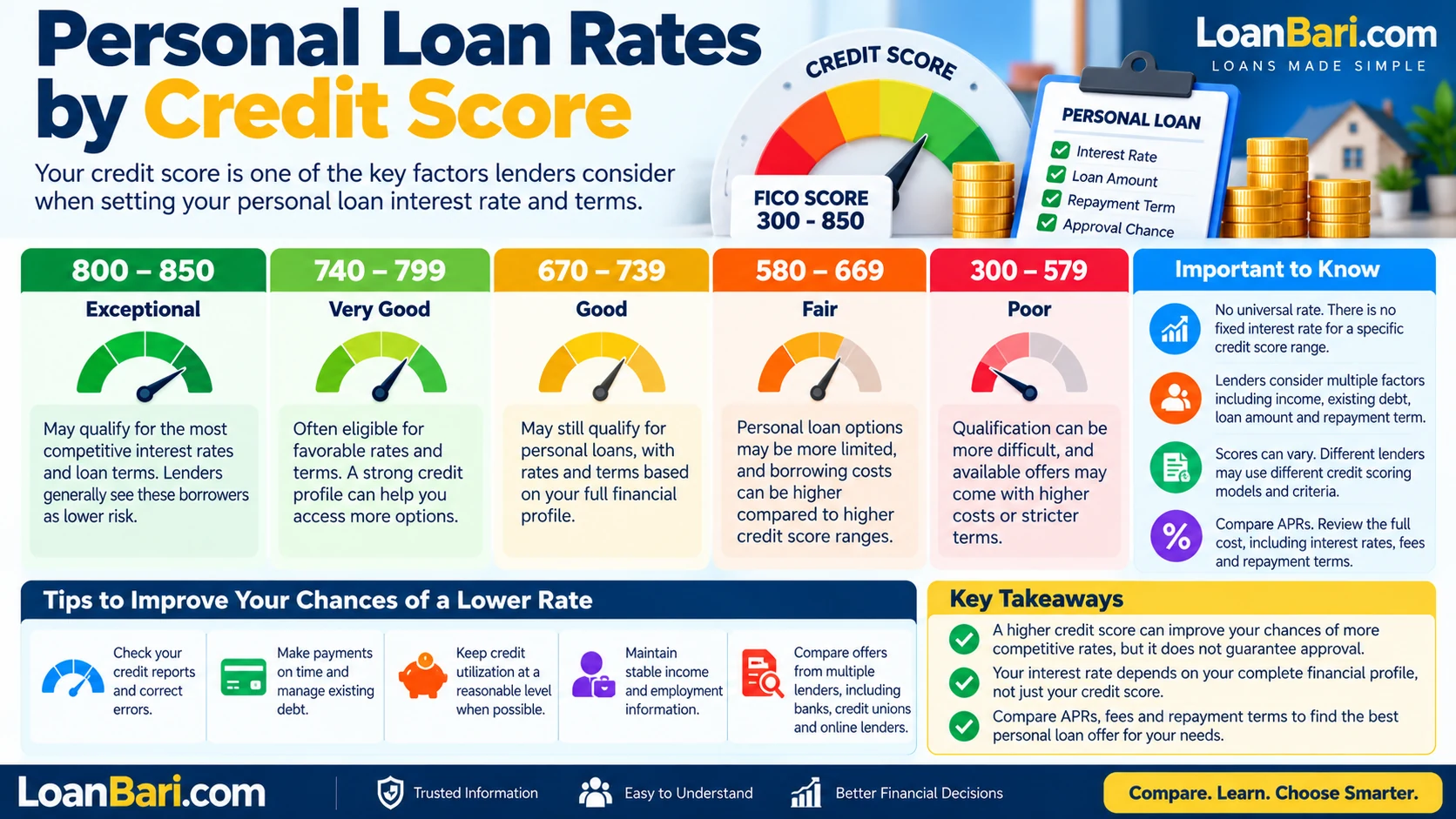
Credit-score categories can help explain differences in borrowing eligibility, but no universal personal loan APR applies to a particular score range.
How Loan Amounts and Repayment Terms Affect Interest Costs
The amount borrowed and repayment period affect both the monthly payment and total interest expense.
Borrowing More Increases Your Exposure
At an unchanged interest rate and term, borrowing a larger principal produces a larger scheduled payment and greater total interest expense.
Borrowing only what you reasonably need can help reduce the total dollar cost, although lenders may impose minimum loan amounts.
Shorter Terms vs Longer Terms
Shorter repayment terms generally mean higher monthly payments but less total interest at the same fixed rate. Longer terms spread principal repayment over more months, usually lowering the monthly payment while increasing total interest.
Example: $10,000 at 12% Annual Interest
| Repayment Term | Estimated Monthly Payment | Total Repayment | Total Interest |
|---|---|---|---|
| 24 months | $470.73 | $11,297.63 | $1,297.63 |
| 60 months | $222.44 | $13,346.67 | $3,346.67 |
In this hypothetical comparison, extending the term from 24 to 60 months reduces the scheduled monthly payment but increases total interest by approximately $2,049.04.
Both examples assume the same fixed annual rate, no fees, standard monthly amortization, and no early payments. Actual lender offers may use different rates for different terms.
How to Calculate Personal Loan Interest
A personal loan interest calculator can help estimate payments before applying. For a standard fixed-rate, fully amortizing loan, the monthly payment can be calculated using the following formula:
M = P × r ÷ [1 − (1 + r)−n]
Where:
- M = scheduled monthly payment
- P = original loan principal
- r = monthly interest rate expressed as a decimal
- n = number of monthly payments
For this model, the monthly rate is the annual nominal interest rate divided by 12. For a zero-interest loan, the monthly payment is simply the principal divided by the number of payments.
Step-by-Step Calculation
Consider a hypothetical $10,000 loan at 10% annual interest for 36 months.
- Principal: $10,000.
- Annual rate as a decimal: 0.10.
- Monthly rate: 0.10 ÷ 12 = approximately 0.00833333.
- Number of payments: 36.
- Apply the monthly amortization formula.
The result is approximately $322.67 per month. Using the unrounded payment, the estimated total repayment is $11,616.19 and the estimated interest expense is $1,616.19.
How to Calculate Total Interest
For this simplified no-fee model:
Total interest = (unrounded monthly payment × number of payments) − principal.
This formula is appropriate for the modeled loan structure, not every loan product. Daily-interest methods, variable rates, fees, irregular payment dates, and early repayments can produce different results.
Personal Loan Monthly Payment Examples
The table below demonstrates how different fixed annual interest rates, principals, and repayment terms affect estimated borrowing costs.
Calculation assumptions: Each example is hypothetical, uses a fully amortizing fixed-rate loan with equal monthly payment intervals, applies the annual nominal interest rate divided by 12, excludes all fees, and assumes no missed or early payments. These are not current lender offers.
| Principal | Annual Rate | Term | Monthly Payment | Total Repayment | Total Interest |
|---|---|---|---|---|---|
| $5,000 | 8% | 24 months | $226.14 | $5,427.27 | $427.27 |
| $5,000 | 14% | 24 months | $240.06 | $5,761.55 | $761.55 |
| $10,000 | 10% | 36 months | $322.67 | $11,616.19 | $1,616.19 |
| $10,000 | 15% | 36 months | $346.65 | $12,479.52 | $2,479.52 |
| $20,000 | 9% | 60 months | $415.17 | $24,910.03 | $4,910.03 |
| $20,000 | 16% | 60 months | $486.36 | $29,181.67 | $9,181.67 |
Payments are displayed to the nearest cent. Total repayment and interest are calculated from unrounded payments, so multiplying a displayed monthly payment by the number of months may differ slightly from the table. A lender’s final installment may also be adjusted for rounding.
What These Examples Show
For the hypothetical $10,000, 36-month loan, increasing the annual rate from 10% to 15% increases total interest from approximately $1,616.19 to $2,479.52.
That is an additional $863.33 in modeled interest, assuming the same principal, repayment period, and no fees.
For a larger $20,000 loan over 60 months, the difference between a 9% and 16% annual rate is much more substantial in total dollars.
The main lesson is to compare both monthly affordability and total repayment, rather than selecting an offer solely because its monthly payment appears manageable.
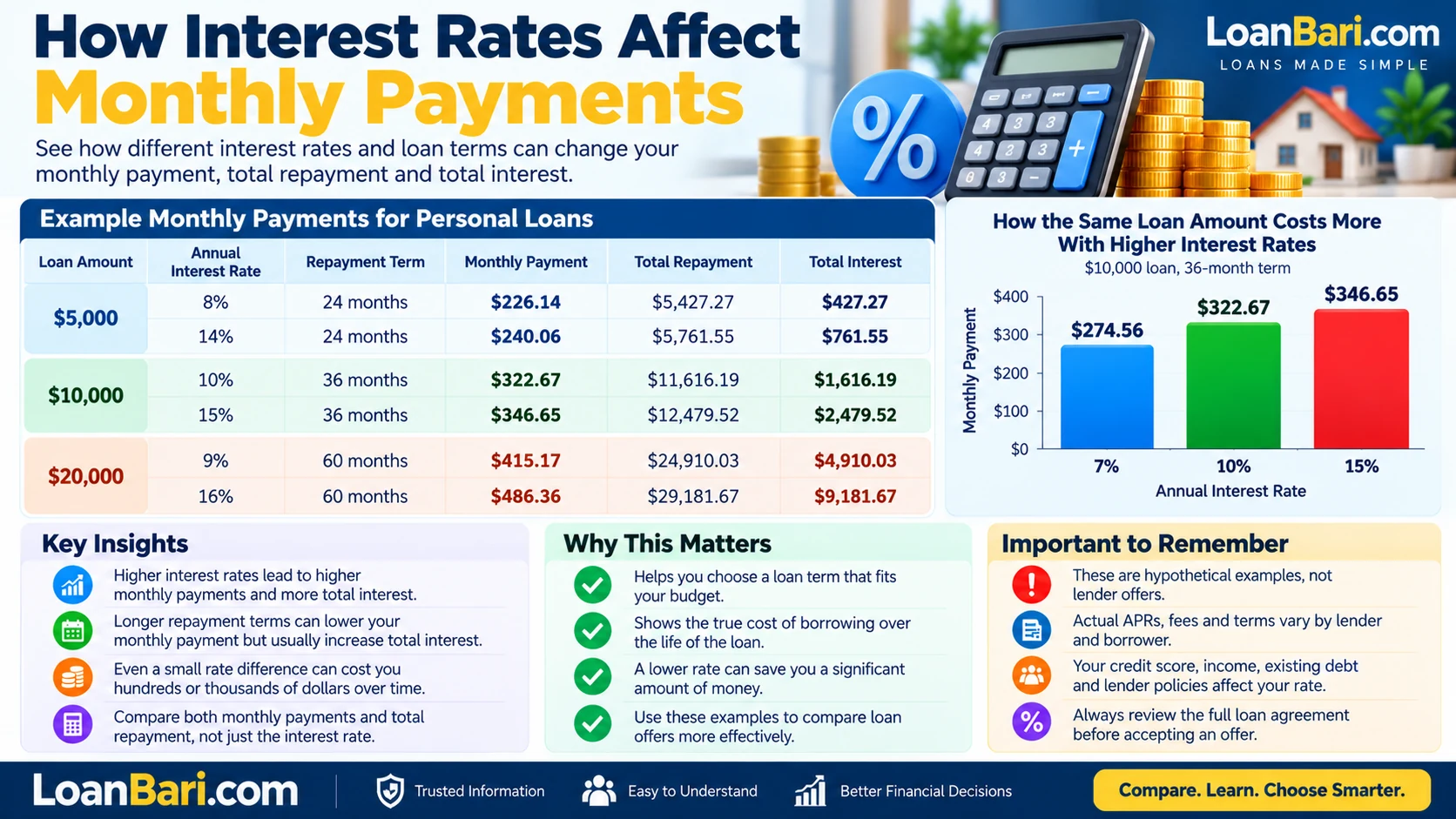
Higher interest rates generally increase monthly payments and total interest when principal and repayment term remain unchanged.
How to Get a Lower Personal Loan Interest Rate
No strategy guarantees a lower rate, but several practical steps may improve your ability to compare offers and qualify for more favorable terms.
1. Review Your Credit Reports
Check your credit reports for inaccurate information and dispute errors through the appropriate process. Correcting errors may help ensure lenders assess accurate information.
2. Maintain Consistent Payment Habits
Paying existing obligations on time can support healthier credit history over time. A single action does not guarantee a specific score increase or loan rate.
3. Reduce Existing Debt When Practical
Lower existing debt obligations may improve affordability and certain credit measures. Prioritize essential expenses and avoid draining emergency savings merely to pursue a loan.
4. Compare Multiple Lenders
Different lenders may offer different APRs and fees to the same applicant. Comparing offers can reveal meaningful differences in total borrowing cost.
5. Explore Prequalification Carefully
Some lenders provide preliminary estimates using a soft credit inquiry. Confirm the type of inquiry and whether proceeding with a full application will trigger a hard inquiry.
6. Consider an Affordable Shorter Term
A shorter term may reduce total interest, but it generally increases the monthly payment. Select a term that fits your budget without creating excessive financial pressure.
7. Ask About Eligible Discounts
Some lenders offer discounts for qualifying automatic payments or other conditions. Check whether the advertised rate already includes those discounts.
8. Consider a Qualified Co-Borrower Where Available
Some lenders permit joint applications. A qualified co-borrower may affect eligibility or pricing, but both borrowers can become legally responsible for repayment.
9. Evaluate Collateral Risks Before Securing a Loan
Secured borrowing may provide another financing option, but pledged assets can be at risk after default. Never assume the possibility of a lower rate automatically justifies that risk.
10. Delay Nonessential Borrowing If Necessary
If available offers are expensive or payments are unaffordable, postponing a discretionary purchase may be financially safer than accepting unsuitable loan terms.
How to Compare Personal Loan Offers
Comparing lenders requires more than looking at the headline interest rate. Request or review the complete terms applicable to your application.
Personal Loan Comparison Checklist
- Compare APRs: Use the disclosed APR to evaluate applicable financing costs.
- Check the interest-rate structure: Determine whether the rate is fixed or variable.
- Review the principal: Confirm the amount borrowed and the amount actually disbursed.
- Check the term: Compare repayment periods and scheduled payment amounts.
- Identify fees: Review origination, documentation, late-payment, and other applicable charges.
- Compare total repayment: Evaluate the expected total dollar cost if the loan is paid according to schedule.
- Review early-payment terms: Determine whether additional payments are permitted and whether charges apply.
- Check funding conditions: Confirm when funds may become available and whether any conditions remain.
- Review consequences of default: Understand collection practices, credit reporting, and collateral risks if applicable.
- Confirm affordability: Ensure the payment fits your budget alongside existing obligations.
Why Comparing the Same Loan Term Matters
Suppose one lender offers a lower monthly payment over 60 months while another offers a higher monthly payment over 36 months. The first offer may feel more affordable each month but could cost more overall.
When comparing offers, use equivalent loan amounts and terms where possible. If the terms differ, evaluate both total cost and payment affordability.
Understand the Amount You Actually Receive
If an origination fee is deducted from loan proceeds, the cash deposited into your account may be lower than the loan’s stated principal.
For example, a hypothetical $10,000 loan with a 3% fee deducted upfront would provide $9,700 in net proceeds. This is a fee illustration, not a lender quotation. The actual disclosed APR and repayment obligations depend on the complete loan terms.
Personal Loan Interest Rates From Banks, Credit Unions, and Online Lenders
Personal loans may be available from banks, credit unions, online lenders, and other finance companies. Each lender evaluates applications according to its own products and policies.
Banks
Banks may offer personal installment loans to eligible borrowers. Their products can differ in credit requirements, repayment terms, origination fees, discounts, and funding procedures.
Credit Unions
Credit unions are member-focused financial institutions. Membership requirements may apply, and available loan products and pricing vary by institution.
Credit unions can be worth comparing, but they do not automatically offer the lowest APR to every borrower.
Online Lenders
Online lenders may provide digital applications, prequalification tools, and electronic loan servicing. However, online convenience does not necessarily mean lower costs or faster approval for every applicant.
Which Type of Lender Is Best?
No lender category is universally cheapest. A borrower should compare actual offers from eligible institutions using APR, fees, repayment terms, total costs, and customer-service considerations.
Also confirm the lender’s identity and applicable licensing or regulatory status before sharing sensitive financial information.
Personal Loan Fees and Other Borrowing Costs
Interest is only one potential component of a personal loan’s cost.
The CFPB notes that personal installment loans may include origination fees, documentation fees, certain insurance charges, late fees, and other charges depending on the agreement.
Origination Fees
An origination fee may be charged for processing or making a loan. Depending on the agreement, the fee may be deducted from proceeds or otherwise included in the financing arrangement.
Documentation or Processing Fees
Some lenders may charge fees associated with loan documentation or administration. Review whether these fees apply and how they are disclosed.
Late-Payment Fees
A missed or late payment may result in charges under the agreement and applicable law. Late payments may also have credit-reporting consequences.
Optional Insurance Products
Some loans may be offered alongside insurance products. Understand whether coverage is optional, what it costs, and what protections it actually provides.
Prepayment Charges
Some agreements may include charges related to early repayment, subject to applicable law and loan terms. Check the contract rather than assuming every personal loan permits penalty-free early repayment.
Returned-Payment Charges
Depending on the lender and account arrangement, an unsuccessful payment may lead to a charge. Your bank or payment provider may also impose separate charges.
For more information, consult the CFPB’s explanation of personal installment loan fees.
Borrower tip: Review the lender’s disclosures and loan agreement before accepting funds. Never rely solely on promotional advertising.
Common Mistakes When Comparing Personal Loan Interest Rates
Comparing an Interest Rate With an APR
A quoted interest rate and a disclosed APR are not interchangeable. Compare equivalent measures when evaluating lenders.
Choosing Only by Monthly Payment
A smaller payment may come from a longer term and can result in more total interest.
Ignoring Upfront Fees
Origination charges may reduce the amount you receive or increase the overall financing cost.
Assuming Advertised Rates Are Guaranteed
Promotional starting rates may apply only to applicants meeting particular criteria. Your actual offer can differ.
Borrowing More Than Necessary
Taking additional funds increases the amount owed and may create unnecessary interest expense.
Overlooking Variable-Rate Risk
A variable rate may increase under the contract, potentially changing the cost of repayment.
Submitting Applications Without Checking Credit Inquiry Policies
Full applications may result in hard credit inquiries. Ask lenders how prequalification and formal applications affect credit reports.
Ignoring the Consequences of Missed Payments
Late payments can lead to fees, collection activity, and negative credit-reporting consequences. Contact the lender promptly if repayment becomes difficult.
Trusting Unverified Lenders
Be cautious of suspicious promises, unclear loan terms, requests for unusual upfront payments, and pressure to act immediately. Verify the institution before providing personal information.
When a Personal Loan May or May Not Make Financial Sense
A personal loan can be useful in certain circumstances, but its suitability depends on the borrower’s alternatives, budget, and financial goals.
When a Personal Loan May Be Worth Considering
- Debt consolidation: A loan may simplify payments or reduce costs if its total borrowing expense is lower than the debt being replaced.
- Necessary expenses: A loan may help cover an important expense when less costly alternatives are unavailable and payments are affordable.
- Predictable repayment: A fixed-rate installment loan may suit borrowers who value a defined repayment schedule.
- Eligible home improvements: Financing may be useful when the project is necessary and the borrower understands the total cost.
When Borrowing May Be a Poor Choice
- The monthly payment would leave insufficient money for essential living expenses.
- The APR and fees make the loan substantially more expensive than realistic alternatives.
- The loan would finance a discretionary purchase that can reasonably be postponed.
- Debt consolidation would create room for additional borrowing without addressing the original spending problem.
- The borrower would risk essential collateral without a sustainable repayment plan.
Alternatives to Consider
Depending on the circumstances, alternatives may include saving for a planned purchase, negotiating a payment arrangement, exploring assistance programs, reviewing an existing creditor’s hardship options, or obtaining guidance from a reputable nonprofit credit counselor.
Compare the costs and consequences of each alternative. A product with a lower monthly payment is not necessarily less expensive overall.
Frequently Asked Questions About Personal Loan Interest Rates
1. What is a personal loan interest rate?
It is the annualized percentage rate a lender charges for borrowing principal. The loan agreement determines how interest is calculated and collected.
2. What is the average personal loan interest rate?
Average rates depend on the source and loan category. The Federal Reserve reported 11.90% for 24-month personal loans at U.S. commercial banks in August 2026, published October 7, 2026. This is a specific historical benchmark, not a universal current offer.
3. What is a good personal loan interest rate?
A competitive rate is one that compares favorably with offers available to a borrower with a similar profile and loan terms. APR, fees, total repayment, and affordability are also important.
4. Is a 10% personal loan interest rate good?
A 10% annual rate may be attractive relative to some available offers, but the answer depends on the borrower, lender, repayment term, fees, and market conditions. Compare the disclosed APR and total cost before deciding.
5. Is APR the same as the interest rate?
No. APR is a broader annualized measure that includes interest and certain applicable finance charges. The interest rate alone generally does not include those additional charges.
6. Do personal loan rates depend on credit scores?
Credit scores and credit histories commonly influence loan underwriting and pricing. However, income, debts, loan terms, and lender policies also matter.
7. Can I get a personal loan with bad credit?
Some lenders consider applicants with weaker credit, but approval is not guaranteed. Available offers may carry higher costs or additional requirements.
8. Are personal loan interest rates fixed?
Many personal installment loans use fixed rates, but variable-rate products also exist. Check the agreement before accepting an offer.
9. Can a personal loan interest rate change?
A fixed rate generally remains unchanged during the agreed fixed-rate period. A variable rate can change according to the contract’s adjustment rules.
10. Does a longer loan term mean lower interest?
Not necessarily. A longer term often lowers the monthly payment but generally increases total interest when the annual rate and principal are unchanged.
11. How is monthly personal loan interest calculated?
For a simplified monthly amortization model, interest for a period is based on the outstanding principal multiplied by the monthly interest rate. Actual lenders may use daily interest or other contractual methods.
12. Can I negotiate a personal loan interest rate?
Some lenders may have flexibility or available discounts, while others use standardized pricing. Asking about eligible discounts and comparing other offers may help identify better terms.
13. Does prequalification affect my credit score?
Some lenders use soft inquiries for prequalification, which do not affect credit scores. A formal application may involve a hard inquiry. Confirm the lender’s specific process.
14. Do banks or credit unions offer lower personal loan rates?
Neither category is always cheaper. Actual pricing depends on the institution, product, borrower, and applicable membership requirements.
15. Can I pay off a personal loan early?
Many agreements allow early repayment, but terms vary. Review whether prepayment charges apply and how extra payments are allocated.
16. Does paying early reduce interest?
For many declining-balance loans, reducing principal earlier can lower future interest. The actual benefit depends on the interest calculation method and any prepayment charges.
17. Can a secured personal loan have a lower rate?
Collateral may influence loan pricing, but a lower rate is not guaranteed. Secured loans can expose pledged property to loss after default.
18. Why do two lenders offer different rates?
Lenders use different funding arrangements, underwriting policies, risk assessments, product structures, and pricing decisions.
19. What happens if I miss a personal loan payment?
Consequences may include late fees, collection activity, and adverse credit reporting. Contact the lender as soon as possible to discuss available options.
20. Should I choose the loan with the lowest APR?
The lowest APR is an important consideration, but it should be evaluated alongside the repayment term, total dollar cost, monthly affordability, restrictions, and other contract conditions.
Final Takeaways: Understanding Personal Loan Interest Rates
Personal loan interest rates are an important part of borrowing, but they do not tell the entire story. A responsible comparison considers the APR, fees, loan amount, repayment term, and total scheduled cost.
The Federal Reserve’s August 2026 benchmark provides useful historical context for 24-month commercial-bank personal loans, but individual offers can vary significantly.
Before accepting a personal loan, review your financial situation, compare available offers, calculate the total cost, and confirm that payments are sustainable.
For further reading, visit our personal loans resource page, learn how personal loans work, or compare secured and unsecured personal loans.
The most suitable loan is not necessarily the one with the smallest advertised monthly payment. It is an offer whose full costs, terms, and risks you understand and can responsibly manage.
Sources and References
The following authoritative resources support the statistical benchmark and financial concepts discussed in this article:
- Federal Reserve Board — G.19 Consumer Credit. October 7, 2026 release, including the August 2026 observation for 24-month personal loans at commercial banks.
- Federal Reserve Economic Data — Finance Rate on Personal Loans at Commercial Banks, 24 Month Loan. Series TERMCBPER24NS, sourced from the Board of Governors of the Federal Reserve System.
- Consumer Financial Protection Bureau — What Is a Personal Installment Loan?. Background on installment loans, underwriting factors, and repayment.
- Consumer Financial Protection Bureau — Do Personal Installment Loans Have Fees?. Discussion of possible fees and the importance of reviewing disclosures.
- Consumer Financial Protection Bureau — Interest Rate vs APR. Explanation of interest and annual percentage rate concepts.
- myFICO — What’s in Your Credit Score?. Educational background on credit-scoring factors.
Research date: October 31, 2026. Historical rate observations may be revised or superseded by later releases. Mathematical examples are hypothetical calculations, not lender offers.
Financial Disclaimer
LoanBari.com provides personalized financial, legal, tax, or lending advice. This article is not a loan offer, approval guarantee, or recommendation of a particular financial product.
Interest rates, APRs, fees, eligibility requirements, repayment terms, and applicable laws vary by lender, borrower, product, and jurisdiction. Readers should review official lender disclosures and consider consulting an appropriately qualified professional when necessary.
All hypothetical payment examples exclude additional fees and assume scheduled repayment under the stated calculation model. Actual lender calculations and final payments may differ.